

.
Enterprise identity decisions rarely fail because a team lacks one more verification check. They fail when signals, policies, application journeys, and review processes sit in separate systems with no consistent way to determine what happens next.
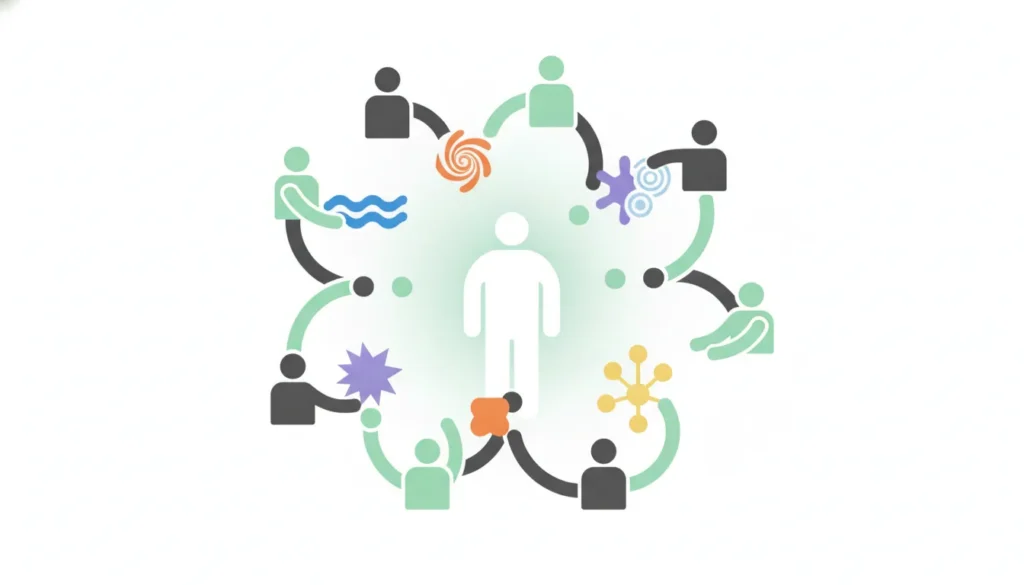
Identity orchestration connects identity signals, verification journeys, policy decisions, exceptions, and lifecycle checks. It helps security, fraud, platform, and trust teams apply the right level of assurance at each point in an experience while preserving a clear record of why a decision was made.
An identity provider can authenticate a user, while an orchestration design coordinates broader decisions across providers, applications, risk signals, and changing circumstances. The practical question is not which single signal should win, but how each signal contributes to a governed decision.
Customer Identity and Access Management in Practice
Customer identity and access management (CIAM) governs how customers register, sign in, recover access, and take sensitive actions.
Identity orchestration coordinates the signals and policies behind those journeys. It gives each decision a clear context, owner, outcome, and audit trail.
A practical CIAM model separates three questions. Who does the customer claim to be? Is the current session trustworthy? What should happen next?
Proofing and authentication address identity and access. Human-presence, uniqueness, device, behavioral, and transaction signals add context.
Policy can then route each result to allow, step up, hold, deny, or review. This separation keeps access decisions explainable.
VerifEye supplies a human-presence and uniqueness signal when a journey needs evidence of a real and unique person.
That model can support Onboard, Reverify, Protect, and Recover. Read more about identity verification versus human presence.
What Is Identity Orchestration?
Identity orchestration is the coordination layer that brings identity signals, verification journeys, policy decisions, exception handling, and lifecycle checks into one operating model. It helps an enterprise decide which signal to use, when to request it, what the result means, and what should happen next.
This coordination may cover account creation, sign-in, high-risk actions, recovery, marketplace participation, age-related controls, or repeated access over time. The right flow does not ask every user for every signal. It applies the relevant policy to the context, routes ambiguous cases for review, and records enough evidence for teams to understand how a decision was reached. For the distinction between two foundational concepts, see identity proofing and verification.
Orchestration Is Broader Than Verification
A verification service can produce an outcome. An orchestration approach governs what the enterprise does with that outcome alongside other signals and constraints. It can account for exceptions, changes in risk, regional requirements, system availability, and the need to re-check a user during an ongoing relationship.
The distinction is straightforward: VerifEye is the human-presence and uniqueness layer that plugs into an orchestration stack. The wider stack owns policy, routing, exception workflows, system integration, and lifecycle governance, while VerifEye supplies a defined signal for moments where human authenticity matters.
Why Identity Orchestration Matters Beyond Point-in-Time Checks
A point-in-time check answers a narrow question: did this signal meet the requirement at this moment? Enterprise risk rarely stays inside one moment or one system. A fraud team may see a suspicious account, a platform team may see unusual behavior, and a security team may see a failed authentication. If those observations remain isolated, each team makes a locally reasonable decision without a reliable view of the wider journey.
Identity orchestration connects those observations to the decisions they inform. It links verification events, application context, policy outcomes, exception handling, and later checks without pretending that every signal means the same thing. See enterprise identity verification architecture for the wider system view.
Risk changes after the first decision. A return through a different device, a sensitive action, or coordinated abuse may warrant another signal. Low-risk activity can proceed with existing evidence, while material change can route the journey to verification, review, or a controlled exception path. Keep the decision record traceable, including evidence, policy, action, and human review. Human uniqueness across accounts is one signal in that wider journey.
How Does Identity Orchestration Work Across Enterprise Systems?
Identity orchestration coordinates context, signals, verification journeys, policy decisions, exception handling, evidence, and repeat checks across the systems that need to make an identity decision.
- Collect relevant context. Start with the event requiring a decision and the systems that already know something about it. Context may include an account action, device or session signal, transaction, or lifecycle change.
- Select signals for the decision. Map each decision to signals that can answer it. Proofing can establish identity claims, while behavioral, device, human-presence, and uniqueness signals add risk context. Keep the taxonomy explicit.
- Route the verification journey. Use context and signal requirements to select a proportionate path. A low-risk return visit may need less friction, while a high-risk action may require verification or review. Account for channel, geography, accessibility, availability, and previous outcomes. See this identity verification API integration checklist.
- Apply policy and return an outcome. Translate the signals into allow, step up, hold, deny, or review. Keep policy ownership separate from individual signal vendors.
- Handle exceptions and record evidence. Route unavailable or contradictory signals to a fallback, manual review, or controlled retry. Capture inputs, policy version, outcome, exception path, and relevant timestamps.
- Re-check when risk changes. Revisit decisions after material changes in behavior, privileges, session context, or lifecycle status. Continuous assurance means defining which changes warrant another look, not repeating every check for everyone.
Which Identity Signals Should an Orchestration Layer Coordinate?
No single signal can answer every identity question. A sound design coordinates signals according to the decision at hand, the confidence required, and the user’s place in a lifecycle. Identity proofing, authentication, human presence, and account context should remain distinct rather than blending into one reassuring but unhelpful score.
| Signal | Question answered Orchestration role |
|---|---|
| Identity proofing | Question answered: Who is this person? Orchestration role: Route proofing, then pass the result to policy. |
| Authentication | Question answered: Who controls the account authenticator? Orchestration role: Use assurance in access and step-up decisions. |
| Behavioral signals | Question answered: Does the interaction fit the expected pattern? Orchestration role: Add context for risk and anomaly review. |
| Human presence | Question answered: Is a real person present? Orchestration role: Strengthen decisions where automation or spoofing is a concern. |
| Uniqueness | Question answered: Does this person appear distinct from identities already seen? Orchestration role: Support duplicate-account and abuse controls. |
| Lifecycle context | Question answered: What changed since the last trusted event? Orchestration role: Trigger re-verification or review when context shifts. |
Key takeaway: Authentication can establish control of an account without proving that the underlying person is unique. A behavioral anomaly can justify another check without identifying its cause.
VerifEye belongs specifically in the human-presence and uniqueness layer. It can contribute document-free signals about whether a real person is present and whether that person appears unique. The wider orchestration design remains responsible for policy, routing, exceptions, and lifecycle context. See behavioral signals for identity decisions for a related perspective.
How Should Policy Decisions and Exception Review Be Governed?
Policy is where an orchestration design becomes accountable. Assign a named owner for each policy, define permitted outcomes, and document which team can approve an exception, for how long, and under what conditions. Each exception should have an owner, a reason code, and a resolution path.
Make decisions explainable and reviewable
Every decision should leave enough context for an authorized reviewer to understand what happened. Record the policy version, relevant signals, decision outcome, timestamp, system or person that made the decision, and any reason code exposed to the user or reviewer. Distinguish a failed check from a missing signal, a policy exclusion, or a deliberate human override.
A reviewer should see the evidence needed to assess the case, the applicable policy, the requested action, and the expiry or follow-up condition. Human review matters when signals conflict, the consequence is material, or the evidence is incomplete. The aim is to make judgment bounded, consistent, and auditable.
Build privacy into the control model
Privacy should shape the journey before a team chooses a threshold or exception path. Select proportionate controls, limit retention, restrict access, and separate decision evidence from unnecessary personal detail. Standards such as ISO/IEC 27001 and SOC 2 can clarify responsibilities, but neither substitutes for sound policy design.
The ICO’s data protection by design guidance makes the same practical point: privacy belongs in the system from the outset, not as a repair after launch.
Good governance is practical governance: clear ownership, proportionate signals, privacy by design, meaningful human review, and an evidence trail that can withstand reasonable scrutiny.
Where Do Human Presence and Uniqueness Fit?
Human presence and uniqueness are signals within an orchestration design. The journey layer decides when to request them and what to do with an inconclusive result. A useful human verification framework places them in a broader decision path.
Proving that someone is real differs from proving a legal identity, authenticating an account, or authorizing access. A platform might use presence during account creation, uniqueness to identify repeat enrollment or coordinated abuse, and other signals later.
VerifEye contributes liveness detection and uniqueness validation through APIs and SDKs, without requiring government ID documents or storing sensitive images. Its human-presence and uniqueness verification capability supplies a defined signal while the application and policy layer determines the next step.
Realeyes’ public platform pages describe Face Credential as a reusable, privacy-safe credential minted at Onboard and reused across Reverify, Protect, and Recover. It is a practical example of continuity across an orchestration stack.
How Can Teams Build an Identity Orchestration Roadmap?
Start with the decisions, not the diagram. Map the business event, signals, policy system, and accountable owner to the lifecycle stages Realeyes uses for its human-verification platform:
- Onboard. Cover account creation and initial enrollment. Define required assurance, signals, consent, and the fallback when a user cannot complete the preferred path.
- Reverify. Cover login, return visits, and material changes in session or account context. Decide when existing assurance is enough and when another check is proportionate.
- Protect. Apply step-up controls to high-risk transactions, privilege changes, coordinated abuse, or unusual activity. Tie the outcome to policy and evidence.
- Recover. Design account recovery without a weak link. Define signals, fallback routes, review ownership, and follow-up checks when the normal authenticator is unavailable.
Pilot one narrow journey with a clear owner and manageable risk boundary. Test unavailable signals, contradictory results, and legitimate users who need an exception. Measure successful completion, review volume, latency, and unresolved exceptions together. Expand only when the operating model is understood.
The goal is not the largest possible signal collection. It is a dependable decision process that can be explained, improved, and governed.
FAQs: Identity Orchestration
What is identity orchestration?
Identity orchestration is the coordination layer that connects identity signals, verification journeys, policy decisions, exception handling, and lifecycle checks. It helps an enterprise apply the right evidence and response at each decision point instead of asking one verification tool to carry the entire identity process.
Is identity orchestration the same as an identity provider?
No. An identity provider typically authenticates users and manages access credentials. Orchestration coordinates that provider with other signals, verification services, risk policies, applications, and review workflows.
Which signals should an orchestration layer coordinate?
The answer depends on the decision. Common inputs include identity proofing, authentication, behavioral signals, device or session context, human presence, uniqueness, and lifecycle changes. Select signals that match the risk and user journey rather than collecting every possible signal by default.
When should an enterprise re-verify a user?
Re-verification should follow meaningful changes in risk, context, or account behavior, not an arbitrary schedule alone. Examples include a sensitive action, a materially different session, signs of account takeover, or a change in the assurance required by the service.
Where does liveness detection fit into identity orchestration?
Liveness detection can provide a human-presence signal within a wider decision flow. VerifEye can contribute evidence that a real, unique person is present, while the enterprise’s orchestration design determines how that result affects policy, exceptions, and case review.
Verify real humans. Without the friction.
VerifEye confirms users are real and unique in seconds. No documents, no stored data, no drop-off.