


Brands spend billions on market research every year, making huge decisions based on what they learn about their customers. But what happens when that data is fundamentally flawed? A growing threat is quietly undermining this entire process. The rise of survey fraud means that carefully collected insights are being corrupted by bots and fake users, skewing results. This isn’t just about wasted money; it’s about companies losing their connection to real people and making critical mistakes based on bad information.
From that industry, we estimate that $1 trillion worth of business and advertising decisions are made based on information gleaned from surveys. Yet, many of those surveys contain too many duplicate users and bots, driving an unacceptable percentage of bad data due to fraud or poor quality.
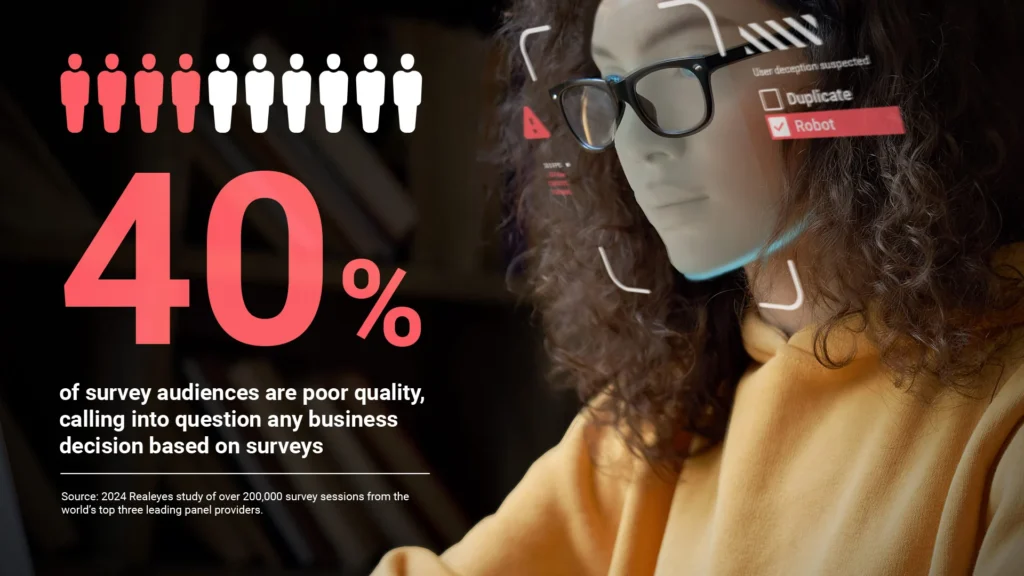
In a recent study of over 200,000 recent survey sessions bought from the top three panel providers, we’ve found over 40% of surveys are bad quality. This seriously calls into question any important decision made as a result.
The Alarming Rise of Digital Fraud
This isn’t just a problem for market research; it’s a symptom of a much larger issue eroding trust across the internet. The same fraudulent activities that pollute survey data are also being used to attack financial institutions, retailers, and government platforms on a massive scale. When systems can’t distinguish between a real person and a malicious actor—whether it’s a bot, a scammer, or a synthetic identity—the consequences are severe. This breakdown in verification doesn’t just lead to bad data; it results in staggering financial losses and undermines the integrity of the digital services we rely on every day. Understanding the scope of this problem is the first step toward building a more secure and trustworthy online environment.
Statistics on the Rise of Different Fraud Types
The numbers paint a clear picture of a problem that is not only widespread but also growing more sophisticated. From small business loans to major real estate transactions, no sector is immune. These statistics highlight the urgent need for better verification methods, showing just how vulnerable current systems are to exploitation by those who know how to game them. The financial impact is immense, but the damage to consumer and business confidence is just as significant, creating a ripple effect across the entire economy.
Financial and Lending Fraud on the Upswing
The financial sector is a primary target, with criminals constantly finding new ways to exploit lending processes. For instance, fraud targeting loans for small and medium-sized businesses (SMBs) is escalating rapidly. A recent survey revealed that a staggering 82% of financial companies saw an increase in SMB lending fraud in the past year alone. This isn’t just a matter of numbers on a spreadsheet; it represents a direct threat to the engines of our economy. When fraudulent applications slip through, it not only causes direct financial loss but also makes it harder for legitimate businesses to access the capital they need to grow and create jobs.
Fraud in Real Estate and Retail
The threat of fraud extends to some of the most significant purchases people make. In the real estate market, mortgage fraud risk has jumped over 8% year-over-year, with estimates suggesting that roughly 1 in every 118 applications contains indications of fraud. This can involve falsified income documents or even stolen identities used to secure loans, putting both lenders and the housing market at risk. Similarly, the retail industry is constantly battling card-not-present fraud, where stolen credit card information is used for online purchases. These attacks chip away at profit margins and force businesses to invest heavily in security measures, with the costs often passed on to consumers.
Understanding Common Fraud Tactics
To effectively combat fraud, you first need to understand the playbook. Fraudsters use a diverse set of tactics, from creating entirely fake people to hijacking real accounts and manipulating human psychology. These methods are not mutually exclusive; they are often combined to create complex schemes that are difficult to detect with traditional security tools. By breaking down the most common approaches, we can see the specific vulnerabilities they exploit. This knowledge is crucial for developing strategies that address the root of the problem: the challenge of verifying that the person on the other side of the screen is real, present, and acting with legitimate intent.
Identity-Based Fraud
This category of fraud strikes at the very core of digital trust: the identity of the user. Instead of just stealing a credit card number, criminals focus on compromising or fabricating an entire persona. This allows them to bypass security checks that are designed to verify a person’s credentials, because they either have the real credentials or have created a new identity that looks completely legitimate on paper. These tactics are particularly dangerous because they can be used to open new lines of credit, take over existing accounts, and cause long-term damage to an individual’s financial reputation.
Synthetic Identity Theft
Synthetic identity fraud is one of the most insidious and fastest-growing forms of financial crime. In this scheme, scammers don’t just steal one person’s identity; they create a new one from scratch by combining real information, like a legitimate Social Security number, with fabricated details like a fake name and address. This “Frankenstein” identity is then used to build a credit history over time, eventually allowing the fraudster to apply for large loans or credit cards and then disappear without a trace. Because there’s no single real person to report the fraud, these synthetic identities can go undetected for years, costing financial institutions billions.
Account Takeover (ATO) Fraud
Unlike synthetic fraud, account takeover (ATO) targets real, existing user accounts. A criminal gains unauthorized access to a victim’s account—whether it’s for banking, email, or social media—by stealing their login credentials. This is often accomplished through phishing scams, malware, or data breaches. Once inside, the fraudster can change passwords to lock the real user out, drain funds, steal personal information, or use the compromised account to scam other people. ATO is a direct violation of a user’s digital life and a major headache for platforms, which have to deal with the financial fallout and the loss of customer trust.
Transactional and Application Fraud
This type of fraud is all about the action. It occurs at a specific point in a process, like during checkout for an online purchase or when someone is filling out a form for a new service. The goal is to exploit a single transaction or application process to gain an immediate financial benefit. These methods are often automated, with bots programmed to test stolen credit card numbers or submit thousands of fraudulent applications at once. They represent a constant, high-volume threat that requires businesses to be vigilant at every customer touchpoint.
Card-Not-Present (CNP) Fraud
If you’ve ever bought something online, you’ve participated in a card-not-present (CNP) transaction. This type of fraud happens when a criminal uses stolen credit or debit card details to make purchases without having the physical card. They might get the information from a data breach, a phishing email, or a skimming device. For ecommerce businesses, CNP fraud is a massive problem. They can be hit with chargebacks from the legitimate cardholder, losing both the product they shipped and the money from the sale, plus any associated fees.
Application Fraud
Application fraud is exactly what it sounds like: someone provides false or manipulated information on an application to get something they aren’t entitled to. This is a huge issue in the lending and insurance industries, where people might lie about their income to qualify for a loan or hide a pre-existing condition to get a better insurance rate. It can also be more malicious, involving the use of stolen or synthetic identities to apply for credit cards or government benefits. This type of fraud forces companies to spend more time and resources vetting every single application.
Wire Fraud
Wire fraud is a high-stakes crime where criminals trick people or companies into sending money to a fraudulent account through electronic communications. One of the most common forms is Business Email Compromise (BEC), where a scammer impersonates a company executive or a vendor and sends an urgent email requesting a wire transfer to a new bank account. Because the request seems legitimate and often has a sense of urgency, employees can be tricked into sending huge sums of money that are nearly impossible to recover once the transfer is complete.
Deception and Social Engineering
Sometimes, the weakest link in security isn’t a piece of software but a person. Deception and social engineering tactics exploit human psychology—our trust, our fear, or our desire to be helpful—to trick us into giving up sensitive information or performing an action that benefits the scammer. These attacks are effective because they bypass technical defenses and go straight to the end user. They remind us that a truly secure system needs to account for the human element and the sophisticated ways it can be manipulated.
Phishing and Spoofing
Phishing and spoofing are two classic social engineering tactics that often go hand-in-hand. Phishing is when a scammer sends a fraudulent message, usually an email or text, that appears to be from a legitimate source like a bank or a well-known company. The goal is to trick you into giving them your personal details, like passwords or credit card numbers. Spoofing helps make the phish more believable by disguising the origin of the message. For example, a scammer might spoof an email address or phone number to make it look exactly like it’s coming from your boss or your bank, making you more likely to trust the message and fall for the scam.
How Does Survey Fraud Actually Happen?
Surveys only work and produce meaningful results if each survey response is a unique human being who pays attention and fills out the survey accurately. Where fraud occurs is if people attempt to fill out the survey multiple times, therefore falsely inflating their answers, or someone uses technology to trick the system into thinking it’s a human filling out the form.
Why Financial Incentives Drive Survey Fraud
Panels often pay “users” to take surveys as it’s seen as a worthwhile value exchange for customer perspectives and is the only way to generate scale. There are plenty of people who follow the rules by only filling out a survey once and actually paying attention to questions and answering honestly.
But there is an unacceptable number of people who try to game the system by taking surveys multiple times, thwarting any simple quality control by pretending to be different people. Of course, this is a laborious process that provides the fraudsters more money, but not enough to make it the industry’s biggest problem.
How Tech Fuels the Rise of Survey Fraud
More concerning is the fraud farms that use technology like generative AI-powered bots and other automation tools to fill out multiple surveys quickly. Doing so produces significant revenue and takes little human effort once the technology is set up.
These bad actors can use that technology to create hundreds or thousands of survey responses in seconds, in ways that will pass the panels’ quality checks or specific criteria.
Now that we’ve determined that survey research is riddled with fraud and quality issues, in our next post, we’ll discuss why survey providers are falling behind in tackling this issue.
How to Spot and Prevent Fraud
Fraudsters thrive on chaos and speed, hoping you’ll react before you have a chance to think. But their methods aren’t as random as they seem; they often follow predictable patterns. Learning these patterns is your first step toward building a solid defense for your business and your customers. This isn’t just about putting out fires. It’s about creating an environment where fraud struggles to even start. This requires a mix of sharp-eyed awareness from your team and proactive strategies that protect your systems from the inside out. By learning to recognize the classic signs of a scam and implementing strong prevention measures, you can dramatically reduce your vulnerability to these attacks.
Recognizing the Red Flags of a Scam
Most scams are designed to trigger a sense of urgency or fear, which can override our natural caution. Whether it’s a phishing email that looks like it’s from a trusted partner or a fraudulent application submitted through your platform, the goal is always the same: to trick you into giving away access, information, or money. Your most effective defense begins with knowing what to look for. Scammers often impersonate legitimate organizations, invent a problem that needs your immediate attention, and pressure you into making a quick decision. Making sure every member of your team can spot these red flags is a critical part of your security posture.
The Four P’s of Spotting Fraud
A simple but effective way to identify scams is by remembering the “Four P’s.” According to federal resources, scammers will almost always: Pretend to be from a familiar organization, like a bank, a government agency, or even one of your suppliers. They’ll present a Problem that requires your immediate action—an overdue invoice, a compromised account, or a pending penalty. Then, they’ll Push you to act quickly, warning that if you don’t, something terrible will happen. Finally, they’ll tell you how to Pay, often in a specific and unusual way, like with gift cards or a wire transfer. This straightforward method helps anyone recognize the classic signs of a social engineering attack.
Proactive Prevention Strategies for Businesses
While spotting scams is essential, a truly effective strategy is proactive, not just reactive. This means building systems and processes that make it much harder for fraud to succeed in the first place. It starts with a long-term commitment to security that involves both your technology and your people. Educating your employees and customers about common fraud tactics is a foundational step. But in an environment where bots and synthetic identities can convincingly mimic human behavior, education alone isn’t enough. Businesses need to invest in technologies that can reliably distinguish between a genuine user and a bad actor, ensuring trust at every interaction.
General Prevention Strategies
A comprehensive fraud prevention plan needs multiple layers. This includes strong internal controls, like requiring multi-person approval for large transactions and regularly auditing accounts. A key, and often overlooked, component is ongoing education. As one industry report points out, a crucial part of any long-term plan is to teach account holders about fraud. This also applies to your own team, who should get regular training on identifying phishing attempts and other threats. Pairing this human-centric approach with technology that can quietly confirm a real person is behind a profile or payment creates a powerful defense, securing your platform without adding friction for legitimate users.
How Financial Institutions Are Responding
The financial sector gives us a clear view of the escalating fraud landscape. In 2023, a staggering 82% of financial companies reported a rise in small and medium-sized business lending fraud, a figure that shows just how sophisticated attackers have become. This isn’t just about stolen credit cards; it involves complex schemes using synthetic identities and automated bots to submit fraudulent applications at scale. In response, these institutions are moving beyond traditional security questions and investing heavily in advanced identity verification technologies. Their goal is to authenticate users with greater certainty at critical moments like onboarding and high-risk transactions.
Resources for Fraud Prevention and Help
You don’t have to face the challenge of fraud on your own. A wealth of information and support is available from government agencies, industry groups, and cybersecurity organizations. These resources can give you the latest information on emerging threats, offer detailed guides for securing your business, and provide help if you do become a victim of fraud. Tapping into these networks means you’re not just relying on your own knowledge but are benefiting from the collective experience of experts dedicated to fighting digital crime. Staying informed and connected is one of the most effective ways to stay ahead of fraudsters.
Government and Federal Resources
Government agencies are on the front lines of this fight and offer excellent resources for both businesses and consumers. The Federal Trade Commission (FTC), for example, provides up-to-date information on common scams and actionable prevention advice at its website, ftc.gov/scams. These agencies also highlight how certain groups are disproportionately targeted, noting that veterans, for instance, are often singled out by scammers because of their benefits. This kind of detailed insight helps businesses understand the specific risks their different customer segments might face, allowing for more tailored protection and education.
Cybersecurity and Awareness Organizations
Beyond government bodies, numerous industry-specific and cybersecurity-focused organizations provide invaluable support. These groups often offer resources tailored to the unique challenges of a particular sector. For example, the Independent Community Bankers of America (ICBA) features a variety of banker resources on fraud, including a comprehensive Check Fraud Guide and specialized online courses. By engaging with organizations relevant to your field, you can access highly specific advice, training materials, and threat intelligence that can help you fortify your defenses against the types of fraud most likely to impact your business and your customers.
Frequently Asked Questions
Why is digital fraud suddenly a bigger problem than it used to be? While fraud has always existed, the scale and sophistication have changed dramatically. The core issue is that technology, like AI-powered bots and automation tools, has made it incredibly easy for bad actors to commit fraud at a massive scale. They can create thousands of fake accounts or submit countless fraudulent applications in the time it would take a person to do just one. This shift from manual, one-off scams to automated, high-volume attacks is what makes the current environment so much more challenging for businesses to manage.
My company doesn’t conduct market research surveys. How does this type of fraud still affect my business? The survey fraud mentioned in the post is just one symptom of a much larger problem: the inability to confirm who is real online. The same tactics used to corrupt survey data—creating fake profiles, using bots to mimic human behavior, and stealing real user information—are used to attack all kinds of businesses. Whether it’s submitting fraudulent loan applications, taking over customer accounts, or committing payment fraud, the root issue is the same. If your business operates online, you’re facing the consequences of this eroded digital trust.
What makes synthetic identity fraud so much harder to detect than traditional identity theft? With traditional identity theft, there’s a real person—a victim—who will eventually notice their account has been compromised and report it. Synthetic identity fraud is far more deceptive because criminals create a new identity by mixing real, stolen information (like a Social Security number) with fake details. Since this “person” doesn’t actually exist, there’s no one to report the crime. The fraudster can then use this synthetic identity to build a seemingly legitimate credit history over months or even years before cashing out, leaving financial institutions with a loss that’s difficult to trace back to anyone.
It seems like human error is a big factor. Is training my team on spotting scams enough to protect us? Training your team is absolutely essential and forms a critical layer of defense. People are often the first line of protection against social engineering tactics like phishing. However, education alone isn’t a complete solution. The most sophisticated fraud schemes are designed to bypass human checks entirely by using bots or creating synthetic identities that look perfectly legitimate on paper. A comprehensive strategy pairs an educated and vigilant team with technology that can verify a real, live person is genuinely present during critical interactions, stopping automated attacks before a human ever has to make a judgment call.
Besides the “Four P’s,” what’s a key proactive step my business can take to get ahead of fraud? A crucial proactive step is to shift your security focus from simply verifying credentials to verifying the human behind the screen. Fraudsters are experts at stealing or faking data like passwords, addresses, and even Social Security numbers. Instead of relying only on information that can be compromised, businesses should implement systems that can confirm the live presence of a real person at key moments, like during account creation or a high-value transaction. This approach directly counters the rise of bots and fake identities, creating a more secure environment for your real customers.
Key Takeaways
- Online Fraud Is a Systemic Business Threat, Not Just a Data Problem: The tactics used to corrupt market research surveys—like bots and fake accounts—are the same ones causing significant financial losses across lending, retail, and other core business operations.
- Scammers Blend Technology and Psychology to Bypass Defenses: Criminals create sophisticated attacks by combining technical exploits, like creating synthetic identities from scratch, with social engineering that preys on human trust to gain access to sensitive systems.
- An Effective Defense Requires Both Human Awareness and Smart Tech: Protect your business by training your team to recognize common scam patterns, like the “Four P’s,” while also implementing technology that can reliably verify a real human is present during critical interactions.