

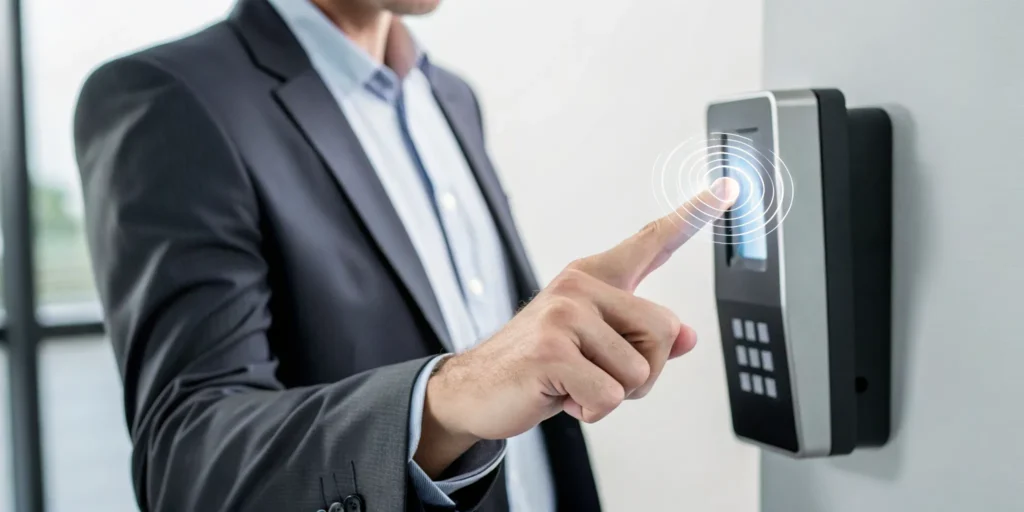
If your password gets stolen, you can change it. If your credit card is compromised, you can cancel it. But what happens if your fingerprint is stolen from a company’s database? You can’t just get a new one. This is the fundamental risk businesses take with traditional biometrics. The entire problem comes down to a single question: how is biometric data stored? For most systems, the answer is a centralized server, creating a permanent liability. But a better way now exists. Using zero knowledge biometrics, it’s possible to verify a user’s identity without ever seeing or storing their data, finally delivering security without the compromise.
Key Takeaways
- Storing user biometrics is a permanent liability: Unlike a password, a stolen face or fingerprint can’t be changed, creating an irreversible security risk for your users and a massive headache for your business.
- Get the security of biometrics without the privacy trade-off: A zero-knowledge approach verifies identity by comparing encrypted codes, which means a user’s actual biometric data never has to leave their personal device.
- Going data-free builds trust and simplifies compliance: When you don’t hold sensitive biometric information, you eliminate a prime target for hackers and prove your genuine commitment to protecting user privacy.
So, What Is Biometric Authentication?
You’ve probably used biometric authentication today without even thinking about it. If you unlocked your phone with your face or logged into an app with your fingerprint, you’ve used your unique biological traits to prove you are who you say you are. At its core, that’s all biometric authentication is: a way of verifying identity using what you are rather than what you know (like a password) or what you have (like a key).
This method moves beyond traditional security questions and complex passwords, which can be forgotten, phished, or stolen. Instead, it relies on characteristics that are unique to each person. This approach offers a powerful way to secure accounts and confirm that a real human is present. But while the concept is straightforward, the way companies handle this sensitive data is what truly matters. The traditional approach of collecting and storing biometric information on central servers creates significant risks, turning a security solution into a potential privacy nightmare. This is the central challenge that modern authentication systems must solve: how to get all the security benefits without creating a honeypot of unchangeable personal data.
From Fingerprints to Faces: Common Biometric Types
When we talk about biometrics, we’re usually referring to two main categories: physical and behavioral. Physical biometrics are based on your unique anatomical features. The most common examples are fingerprint scanning, facial recognition, and iris or retina scans. These are the methods you see most often for unlocking devices or passing through airport security. Behavioral biometrics, on the other hand, analyze patterns in your actions. This can include your unique voiceprint, the rhythm of your typing, or even the way you walk. Each of these traits has distinct patterns that can be measured and used to confirm your identity with a high degree of accuracy.
Debunking Common Myths About Biometric Data
The idea of using your face or fingerprint as a key can feel futuristic, and with that comes a lot of questions and a few persistent myths. It’s easy to let scenes from spy movies shape our understanding, but the reality of modern biometrics is far more nuanced and secure. Let’s clear up some of the most common misconceptions about how this technology actually works and what it means for your personal data. Getting the facts straight is the first step toward building systems that are both secure and respectful of user privacy, proving that we don’t have to sacrifice one for the other.
Myth: Biometric Data Is Easy to Copy
One of the biggest fears is that a thief could just use a photo of your face or a copy of your fingerprint to break into your accounts. This is a valid concern, but it misunderstands how biometric systems store information. They don’t keep a picture of your face on file. Instead, they convert your unique features into a complex, encrypted mathematical representation, often called a template. According to security experts at Anonybit, modern systems store these encrypted templates, not actual images, and are equipped with technology to spot fakes. This means holding up a photo to a camera won’t work, as sophisticated “liveness” detection can tell the difference between a real, present person and a static image.
Myth: Biometric Systems Are Flawless
While biometric authentication is a huge leap forward in security, no technology is perfect. It’s a myth that these systems are infallible. On rare occasions, a facial scan might fail in poor lighting, or a fingerprint reader could reject your thumb if the sensor is smudged. These issues, known as false rejections or, much more rarely, false matches, are possibilities. This doesn’t mean the technology is unreliable; it just highlights that the quality of the hardware and software truly matters. Acknowledging that these systems can make mistakes is crucial for building responsible security protocols that may include backup verification methods for those just-in-case moments.
Myth: Biometric Data Cannot Be Anonymized
Many people believe that once your biometric data is captured, it’s tied to your identity forever and can’t be made anonymous. This is perhaps the most critical myth to bust, especially for privacy-focused companies. The truth is, biometric data can and absolutely should be anonymized. Innovative systems do this by breaking the encrypted data into multiple pieces, distributing them, and making it impossible to reassemble them into the original template. This decentralized approach means there is no single, vulnerable database for hackers to target. It’s a powerful way to protect individual privacy while still getting all the security benefits, proving that strong authentication doesn’t have to come at the cost of personal data.
How Is Biometric Data Stored Traditionally?
Traditionally, using biometrics meant a company would scan your face or fingerprint, create a digital template from it, and store that template on its servers. When you needed to log in again, the system would perform a new scan and compare it to the stored file. The problem is, this forces a difficult choice between security and privacy. Storing this sensitive information creates a massive liability. Unlike a password, you can’t change your fingerprint or your face if it’s stolen in a data breach. Once that unique data is compromised, it’s compromised forever, creating a permanent risk for the user. This method turns a person’s identity into a file that can be lost or stolen.
From Raw Image to Encrypted Template
First, let’s clear up a common misconception. Reputable systems don’t store a photo of your face or a picture of your fingerprint. Instead, when you enroll in a biometric system, it scans your feature—say, the unique ridges of your fingerprint—and converts it into a digital representation. This isn’t an image but a unique mathematical code known as a template. This template is then encrypted, turning your unique biological information into a secure string of characters. According to the security experts at Anonybit, this template is incredibly difficult to reverse-engineer back into the original image without highly specialized tools, adding a critical layer of protection. The real question isn’t what is stored, but where it’s stored.
On-Device Storage
The most common and secure method for consumer technology is on-device storage. If you use Apple’s Face ID or Windows Hello, you’re already familiar with this. Your biometric template is encrypted and stored locally in a secure element on your smartphone or laptop, and it never leaves your device. This approach is fantastic for privacy because it drastically minimizes exposure; your data isn’t transmitted or held on a company’s server where it could be targeted in a breach. The trade-off, however, is that this method limits authentication to that single device. If you want to log in from a new computer, you have to re-enroll, as your biometric identity is tied to your hardware.
Centralized and Cloud Databases
In contrast, some applications, particularly in large enterprises or government systems, require identification across many different devices and locations. To achieve this, they often rely on centralized or cloud-based databases. In this model, your biometric template is stored on a central server. While this allows for greater flexibility, it also introduces significant risk. A single database containing thousands or millions of biometric templates becomes an extremely valuable target for hackers. To counter this, these systems require robust security measures like heavy encryption and strict access controls, but the fundamental risk of a large-scale breach remains.
Distributed Storage and Portable Tokens
A more modern and secure approach to server-side storage involves distributing the data. Instead of holding the entire biometric template in one place, the system breaks it into multiple encrypted pieces. These pieces are then stored across different servers, sometimes in different geographic locations. When you need to authenticate, the system checks the pieces without ever reassembling them into a whole template. This method, sometimes called sharding, dramatically improves security. Even if one server is compromised, the attackers only get a useless fragment of the data, not the complete key to someone’s identity. It offers much stronger protection and redundancy than a single, centralized database.
The Big Problem with How We Store Biometric Data
While using a face or fingerprint to log in feels seamless, the traditional method of storing that biometric data on a central server creates enormous risks for your business and your users. This approach turns your servers into a treasure chest for attackers, exposing you to breaches, permanent user data loss, and serious legal trouble.
Your Biggest Vulnerability: Data Breaches
Any time you store sensitive information, you create a target. When it comes to biometrics, that target is especially valuable. Organizations that collect and store biometric information are prime targets for cybercriminals, as this data is seen as the ultimate key to a person’s digital life. Unlike a password database, which can be encrypted, raw biometric templates stored on a server represent a single point of failure. If a breach occurs, the damage is irreversible, and the trust you’ve built with your users can be shattered in an instant.
When a Face Becomes a Stolen Password
Here’s the most critical problem with storing biometric data: you can’t reset your face. Unlike passwords, biometric data cannot be changed if it’s stolen. Once compromised, an individual’s unique identifiers, like their facial geometry or fingerprint, are permanently at risk. This isn’t just an inconvenience; it’s a permanent threat to a user’s identity across every platform they use. For your business, this means a data breach doesn’t just create a temporary security headache. It creates a lifelong liability for every user whose data was exposed, fundamentally breaking the promise of safety you made to them.
Beyond Breaches: Spoofing and Secondary Use
Even if you manage to secure your servers perfectly, the risks don’t stop there. The very existence of a biometric database creates opportunities for new kinds of attacks. Sophisticated actors can use high-quality photos, fake fingerprints, or voice recordings to fool biometric scanners in what’s known as a “spoofing” attack. As AI and deepfake technology become more accessible, the potential for creating convincing fakes will only grow, making it harder for systems to distinguish between a live person and a digital impersonation. Beyond active attacks, there’s also the issue of secondary use. When you collect a user’s biometric data for one purpose, like authentication, what stops it from being used for another, like surveillance or marketing, without their explicit consent? This mission creep turns a security tool into a privacy liability.
Measuring the Risk: False Acceptance and Rejection Rates
No biometric system is perfect, and its performance is measured by two critical metrics. The first is the False Accept Rate (FAR), which tracks how often a system incorrectly authenticates an unauthorized person. While a good system might have a FAR of just one or two mistakes in 100,000 attempts, that’s not zero. For a platform with millions of users, that could still mean hundreds of fraudulent logins. The second metric is the False Reject Rate (FRR), which measures how often the system mistakenly rejects a legitimate user. A high FRR leads to frustrated customers locked out of their accounts, creating a terrible user experience. There’s a constant tension between these two rates: tightening security to lower the FAR often increases the FRR, and vice versa. This trade-off forces businesses to choose between stronger security and a smoother user experience.
Meeting Privacy and Compliance Standards
Regulators are paying close attention to how companies handle personal data, and biometrics are at the top of the list. Strict data privacy laws like GDPR in Europe and various state-level regulations in the US impose severe penalties for mishandling this information. Storing biometric templates can easily put you in a legal gray area, or worse, in direct violation of these rules. The fines for non-compliance can be staggering, not to mention the reputational damage. Adopting technology that authenticates users without storing their data is the clearest way to ensure you meet strict data privacy laws and protect your business from legal risk.
Understanding GDPR and Its “Special Category Data”
If you have users in Europe, the General Data Protection Regulation (GDPR) isn’t just a suggestion—it’s a strict set of rules with serious consequences. Under GDPR, biometric data is considered “special category data,” putting it in the same high-risk bucket as genetic information and health records. This classification means you need explicit consent to process it and must apply extra safeguards. The penalties for getting this wrong are severe, with potential fines reaching up to 4% of your company’s global annual revenue. Storing this kind of information creates a constant compliance burden, forcing you to prove you’re handling it perfectly. The simplest way to avoid this risk entirely is to not store the data in the first place.
Navigating U.S. Laws Like BIPA
In the United States, the rules around biometric data are a complex patchwork that varies from state to state. While there isn’t a single federal law like GDPR, some states have taken a very aggressive stance. The best example is Illinois’ Biometric Information Privacy Act (BIPA), which has become a model for data protection and a source of major class-action lawsuits. BIPA requires companies to get written consent before collecting biometric data and has led to significant legal challenges for businesses that fail to comply. This trend toward stricter state-level regulation means that even if you’re only operating in the U.S., you can’t afford to be complacent. The legal landscape is constantly shifting, making the choice to authenticate users without storing their data the most future-proof strategy.
A Better Way: Introducing Zero-Knowledge Biometrics
For a long time, it felt like we had to make a choice: strong security or user privacy. Using biometrics offered incredible security, but it came with the huge responsibility of storing sensitive personal data. What if you could have the security of biometrics without ever holding onto the data itself? That’s exactly what zero-knowledge biometrics makes possible. This approach fundamentally changes the game by verifying a user’s identity without ever accessing, storing, or sharing their raw biometric information.
It’s a way to prove someone is who they say they are without them having to hand over their most personal data for safekeeping. This method sidesteps the risks of data breaches and privacy violations entirely, allowing you to confirm a real human is present while giving your users complete control over their information. Instead of creating a central vault of faces or fingerprints that becomes a prime target for hackers, you eliminate the target altogether. It’s not a compromise between security and privacy; it’s a smarter system built for a world where both are non-negotiable. This shift allows businesses to build deeper trust with their users, demonstrating a genuine commitment to protecting their most personal information from the ground up.
What Makes Zero-Knowledge Systems Different?
Traditional security often forces a trade-off between robust protection, user privacy, and a smooth experience. Zero-knowledge systems break this pattern by cleverly combining advanced cryptography with biometrics. The core idea behind Zero-Knowledge Biometric Authentication is to confirm a user’s identity without the system ever “seeing” the biometric data itself.
Think of it like proving you know a secret password without ever saying the password out loud. The system can verify that you have the correct information without you having to reveal what that information is. This means you get the high-assurance security of a facial scan or fingerprint without the massive liability of storing that data in a central database.
A Quick Guide to Cryptographic Hashing
So, how does this work in practice? It starts with the enrollment process. When a user first registers, their face or fingerprint is scanned on their own device. Instantly, that scan is transformed into a complex, encrypted mathematical representation, often through a process called secure Multi-Party Computation (sMPC). This encrypted version, or hash, is what gets stored.
The crucial part is that this process is a one-way street. No one, not even your own security team, can reverse-engineer this encrypted data to reconstruct the original biometric scan. The technology behind Zero-Knowledge Biometrics ensures the raw, sensitive information never leaves the user’s device, turning a potential privacy risk into a secure, irreversible code.
The Simple Math That Makes It All Work
The real elegance of this system appears during authentication. When a returning user wants to log in, they perform a new biometric scan on their device. Just like during enrollment, this new scan is immediately converted into the same type of encrypted hash. This newly created hash is then sent to the server to be compared to the one stored during enrollment.
The system’s only job is to answer one simple question: do these two encrypted codes match? If they do, access is granted. If they don’t, it’s denied. The server never sees a face or a fingerprint, only a string of code. It’s a simple mathematical comparison that powerfully protects user privacy while confirming identity with incredible accuracy.
How Can You Authenticate Without Storing Data?
It might sound impossible to verify a person’s identity without ever storing a picture of their face or a map of their fingerprint. For a long time, security teams had to make a tough choice between strong security, user privacy, and a smooth experience. If you wanted one, you often had to sacrifice another. But what if you could have all three?
A modern approach called Zero-Knowledge Biometrics (ZKB) makes this possible. It uses advanced cryptography to confirm a user’s identity without ever seeing, storing, or sharing their actual biometric data. This method allows you to prove a user is who they say they are, all while the sensitive information itself remains completely private and secure. It’s a fundamental shift in how we think about digital identity, moving the industry away from risky data storage and toward a more private, secure future. This isn’t just a theoretical concept; it’s a practical solution that addresses the core tension in digital authentication. By separating the act of verification from the need for data storage, platforms can offer the convenience of biometrics without the inherent risks of holding onto such personal information. This approach not only protects users but also shields businesses from the massive liability that comes with managing sensitive data.
How to Verify Users Without Storing Templates
The core idea behind a zero-knowledge system is to confirm a user’s identity without a central database of biometric templates. Instead of storing a picture of your face, the system stores a heavily encrypted mathematical representation of it. This process is designed to be a one-way street; the encrypted code cannot be reverse-engineered to reveal the original face scan. This is why it’s called “zero-knowledge.” The authentication server never “knows” anything about the user’s actual biometric features. It only knows enough to confirm a match, which is a huge step forward for both privacy and security.
How It Works: Real-Time Matching
The process is surprisingly straightforward for the user and happens in two key moments: enrollment and verification. During enrollment, the user takes a selfie on their device. That image is immediately converted into an encrypted code right there on the device itself. This encrypted code is the only thing that gets stored. No one, not even the platform, can reconstruct the original selfie from this code. When the user needs to authenticate again, they simply take another selfie. This new image is also converted into a temporary encrypted code on their device. The system then uses a secure method to compare the new code with the stored one. If they match, access is granted. The system only ever compares two encrypted codes, never two images.
The Power of On-Device Authentication
The most critical part of this process is that the user’s raw biometric data never leaves their personal device. The conversion from a selfie to an encrypted code happens locally. This means you aren’t transmitting or storing the very thing you need to protect. Because the system doesn’t hold the keys to your users’ biometric identities, it removes the central point of failure that makes traditional databases such a tempting target for attackers. This approach gives users true ownership over their data and gives your platform a way to provide secure authentication without the massive liability of storing sensitive information.
What You Gain by Not Storing Biometric Data
Switching to a data-free authentication model isn’t just a technical upgrade; it’s a fundamental shift in how you approach security, privacy, and user trust. By verifying users without ever storing their sensitive biometric information, you sidestep some of the biggest challenges facing online platforms today. This approach allows you to confirm that a real person is behind the screen while giving your users the privacy they expect and deserve. It’s about building a more secure and trustworthy digital environment from the ground up, where you can protect your systems and your community without becoming a custodian of their most personal data. This move has a ripple effect, simplifying compliance, strengthening security, and ultimately giving you a powerful competitive advantage.
Give Your Users True Privacy
When you tell a user you’re using biometrics, their first thought is often, “Where is my data going?” With a zero-knowledge approach, you have the best possible answer: nowhere. Because the system never stores a user’s raw biometric data, it remains completely private and under their control. This method is so effective that technologies built on this principle can be fully compliant with strict privacy regulations like GDPR, as the cryptographic templates they use are not considered sensitive personal data. You’re not just promising privacy; you’re delivering it by design. This gives users genuine peace of mind, knowing their most unique identifiers are not sitting in a database waiting to be compromised.
Eliminate Your Biggest Security Headache
A centralized database of biometric information is a hacker’s dream and a security team’s nightmare. If breached, the consequences are catastrophic because, unlike a password, a person can’t change their face or fingerprint. Storing this kind of data creates an immense and permanent liability. By adopting a data-free authentication system, you completely eliminate this risk. There is no central honeypot of biometric data to attack, so a data breach simply can’t expose it. This move takes a huge weight off your shoulders, freeing up your security resources to focus on other threats instead of constantly guarding a vault of unchangeable personal information.
Build Trust by Giving Users Control
Trust is the currency of the digital world, and it’s earned through transparency and respect for user autonomy. A zero-knowledge system puts users firmly in the driver’s seat. By using advanced cryptography to verify identity without ever accessing the raw biometric data, you are demonstrating a clear commitment to their privacy. You can confidently tell your users that their information never leaves their device in a recognizable form. This transparency is a powerful way to build customer trust, showing them that you value their security as much as they do. When users feel in control, they are more likely to engage with your platform and become loyal advocates for your brand.
Make Compliance Simple
Navigating the complex web of global data privacy laws can be a major drain on resources. Regulations are constantly changing, and the penalties for non-compliance are steep. A zero-knowledge biometric system simplifies this challenge immensely. Since you aren’t storing sensitive biometric data, you sidestep many of the most stringent requirements associated with its collection and storage. This approach offers the robust security of a centralized system without the associated privacy and compliance burdens. It’s a forward-thinking strategy that makes it easier to adhere to current and future data protection regulations around the world, reducing legal risk and administrative overhead.
Scale Securely Without Slowing Down
As your user base grows, a centralized database of sensitive information becomes an increasingly heavy and risky asset to manage. A data-free approach, however, is built for scale. Because authentication happens without creating a central point of failure, you can onboard millions of users without exponentially increasing your security risk. This decentralized model is inherently more resilient and efficient. You can expand your platform with confidence, knowing your authentication system can handle the growth without becoming a bottleneck or a bigger target for attackers. This is how you future-proof your security infrastructure, allowing you to focus on innovation instead of data management.
Overcoming Common Challenges with Zero-Knowledge Biometrics
Switching to a data-free authentication model is a game-changer for security and user privacy. But like any significant tech upgrade, it’s not as simple as flipping a switch. While the benefits are clear, it’s smart to go in with a realistic understanding of the challenges you might face. Thinking through these potential hurdles ahead of time is the best way to ensure a smooth and successful rollout for your platform and your users.
The good news is that these challenges are well-understood and completely solvable with the right strategy and technology partner. From the initial technical setup to getting your users excited about the change, a thoughtful approach makes all the difference. Let’s walk through the four main areas to consider as you plan your move to a more secure, privacy-first authentication system.
Tackling the Technical Side of Implementation
Let’s be real: the cryptography behind zero-knowledge proofs is complex. This isn’t a simple plug-and-play script. The protocols can be computationally intensive, which means they require significant processing power to run quickly and at scale. For your team, this translates into a technical lift. You’ll need to ensure your infrastructure can handle the load without creating bottlenecks or slowing down other services. The key is to choose a solution that is optimized for performance, so the powerful security operations happening in the background don’t compromise the speed your users expect.
Keeping It Fast and Frictionless for Users
The last thing you want is for your new, ultra-secure authentication process to feel slow or clunky. User experience is everything. While the technology is powerful, its implementation can be complex and currently lacks standardization across the industry. This means the responsibility falls on your team and your tech partner to create an experience that is both secure and completely seamless. The goal is for the user to verify their identity in an instant, without ever having to think about the sophisticated cryptographic checks happening behind the scenes. A successful implementation makes the best security feel invisible.
Getting Your Users On Board
Users are rightfully cautious about how their biometric data is handled. Even though a zero-knowledge system is designed to protect them, they may not understand the distinction at first. This is where clear communication becomes your most important tool. You can’t just roll out the feature; you have to educate your users on why it’s better and safer for them. Explaining that their biometric information never leaves their own device is a powerful message. Being transparent about your data practices is essential to prevent compromising individuals’ privacy or security and to build the trust needed for widespread adoption.
How to Integrate with Your Current Tech Stack
Your company already has a complex web of existing technologies, and any new solution needs to integrate smoothly. Introducing zero-knowledge biometrics represents a new paradigm for identity management, and it must work with your current infrastructure, not against it. The key is to look for solutions built with integration in mind, offering flexible APIs and SDKs that can plug into your current identity and access management (IAM) systems, security protocols, and user databases. The goal isn’t to rip and replace your entire stack, but to add a powerful new layer of trust and security that enhances what you already have.
Ready to Go Data-Free? Here’s Your Roadmap
Switching to a zero-knowledge biometric system is a powerful move for your platform and your users. It shows a deep commitment to privacy and security that builds incredible trust. But like any significant upgrade, it requires a thoughtful plan. Think of it less as a technical overhaul and more as a strategic initiative. A successful rollout focuses on performance, clear communication, and a seamless user experience. Here’s a practical roadmap to guide you through the process and set your team up for success from day one.
Optimize Your Infrastructure for Performance
New technology often comes with new performance considerations, and zero-knowledge proofs are no exception. Some ZKP protocols can be computationally intensive, which might impact speed if not handled correctly. Before you roll out a new system, it’s smart to assess your current infrastructure. Work with your engineering team to understand potential bottlenecks and plan for scalability. The goal is to ensure the authentication process remains instant and invisible to the user. Partnering with a provider that has already engineered a lightweight, high-performance solution can help you sidestep these challenges entirely, letting you focus on integration rather than reinvention.
Educate Users and Build Lasting Trust
Your users are likely familiar with biometrics, but the concept of “zero-knowledge” will be new to most. This is your opportunity to build serious trust. Start by highlighting the benefits of biometric authentication they already appreciate, like stronger security and convenience. Then, introduce the added layer of privacy you’re providing. Explain in simple terms that their face or fingerprint is never stored or turned into data on a server. This message is incredibly powerful. You can communicate this through onboarding screens, FAQ pages, and email announcements. When users understand you’re protecting them in a way others aren’t, their confidence in your platform grows.
Be Transparent with a Clear Privacy Policy
Your privacy policy is more than just a legal document; it’s a promise to your users. When you adopt a data-free authentication method, your policy should reflect that. Regulations across the globe treat biometric data as sensitive information, which comes with strict rules for collection and use. By not storing this data, you simplify compliance dramatically. Update your privacy policy to state clearly and proudly that you use zero-knowledge biometrics and that no user templates are ever stored on your servers. This transparency is a key differentiator that demonstrates your commitment to protecting user privacy, turning a legal requirement into a competitive advantage.
Best Practices for a Seamless Integration
The most effective security tools are the ones that work effortlessly within your existing systems. Zero-knowledge proofs are a revolutionary approach to identity, and integrating them should feel like an upgrade, not a disruption. Look for a solution that offers a straightforward API and clear documentation that your developers can run with. The ideal integration is one that enhances security behind the scenes without adding friction for your users or a heavy lift for your team. A smooth integration ensures that you can protect your platform and your community without slowing down the user experience or your development cycle.
Related Articles
- Zero-Knowledge-Proof: The Ultimate 2026 Guide
- Anonymous User Verification: A Complete Guide
- Biometrics Without Storing Data: A 2026 Guide
Frequently Asked Questions
How is this different from the Face ID on my phone? The core idea is similar, but the application is different. Your phone’s Face ID stores your facial map in a secure chip on the device itself. A zero-knowledge system applies that same principle of keeping data local but for online platforms. It converts your selfie into an irreversible encrypted code right on your device before anything is sent to a server. The platform only ever stores this secure code, not your actual face, which is a much safer approach for web-based authentication.
If you don’t store my biometric data, what exactly is stored? Instead of storing a picture or template of your face, the system stores a unique mathematical code that is generated from it. Think of it as a secure, digital signature of your selfie, created through a process called cryptographic hashing. This process is designed to be a one-way street. The code can be used to confirm a match with a new selfie, but it’s impossible for anyone to reverse-engineer it to see the original image.
Is this process slower for the user than traditional logins? Not at all. The entire process, from taking a selfie to the cryptographic comparison, is designed to happen in a fraction of a second. From the user’s perspective, the experience is as fast and seamless as any other modern login method. All the complex security work happens instantly in the background, so you get top-tier protection without adding any friction or waiting time for your users.
What happens if the encrypted code is stolen from your servers? This is the beauty of the system. Since the stored code is an irreversible, encrypted hash, it’s essentially useless to an attacker on its own. It cannot be used to reconstruct the original biometric data, so it can’t be used to impersonate a user on other platforms. The code’s only function is to be compared against a new, freshly generated code during a live authentication attempt, making it a dead end for bad actors.
How does this approach help with data privacy laws like GDPR? Many data privacy laws have very strict rules about collecting and storing sensitive personal information, and biometrics are at the top of that list. Because a zero-knowledge system never stores the raw biometric data, it helps you sidestep many of these complex requirements. The encrypted codes are often not even classified as personal data under these regulations, which dramatically simplifies your compliance efforts and reduces legal risk.