


Our annual offsite has always been a big deal. In the past, it meant bringing our teams from London, Tokyo, and Boston together in one exciting place for a few days of connection. But one year, we traded plane tickets for VR headsets. Instead of a hotel conference room, we met in a virtual one. It was a huge experiment in hosting a company offsite in VR, and it taught us so much about the future of remote work. Here’s exactly how it went—the wins, the challenges, and the surprisingly human moments we shared.

Realeyes’ annual offsite for 2020 took place in virtual reality. Instead of flying our employees to a single destination, the company sent 75 of the new Oculus Quest 2 VR headsets to our employees across the globe. Realeyes employees convened for two days in a virtual conference hall developed by AltSpace to hear from executives, guest speakers, and most importantly to interact with colleagues.
After comparing the virtual offsite with what we typically experience in person, a few key takeaways stand out. Here’s what you should consider if you’re thinking about a VR event:
1. The initial investment – a cost-benefit analysis for travel versus VR
2. Equipment availability – technology procurement for both hardware and applications
3. The prep work – virtual event setup and logistics
4.The programming – compelling content and employee value
5. Employee engagement – best ways to bring employees together in smaller groups
6. The unique challenges – headset fatigue, and technical demands
7. Long-term considerations – what other problems can we solve with exciting new technology?
Why Host a Company Offsite in Virtual Reality?
In a world of remote and hybrid work, fostering genuine team connection is one of the biggest challenges leaders face. We’ve all spent countless hours on video calls, but the feeling of being in the same room—the casual side chats, the shared laughter, the collaborative energy—is nearly impossible to replicate through a 2D screen. This is where virtual reality steps in, offering a compelling alternative that bridges the gap between digital convenience and human presence. A VR offsite isn’t just a novelty; it’s a strategic tool for building a cohesive, engaged, and forward-thinking company culture.
Hosting an offsite in VR transforms a standard meeting into a memorable, shared experience. Instead of simply watching presentations, your team can interact within a custom-built virtual space, walk up to a colleague’s avatar for a one-on-one conversation, or break out into groups for immersive problem-solving activities. This creates a powerful sense of togetherness that video conferencing lacks. For a global company like Realeyes, it also presents a practical solution, eliminating the immense logistical and financial costs of international travel while still bringing everyone together in a meaningful way. It’s an investment in connection, innovation, and the future of work.
Understanding the Current VR Landscape
If your only exposure to virtual reality has been through gaming or sci-fi movies, you might be surprised by how much the technology has matured. VR is no longer a niche hobby; it has become a major technological force across dozens of industries. Businesses, in particular, are driving its rapid adoption. According to industry analysis, the market is growing quickly as more companies use VR for practical applications like employee training, product design, and, of course, remote collaboration. This isn’t about escaping reality—it’s about enhancing it and finding new ways to connect and create.
The ecosystem of hardware, software, and development tools is now robust enough to support sophisticated corporate events. Major tech companies are investing billions to make VR more accessible, powerful, and user-friendly, signaling that the technology is here to stay. For any company looking to plan a virtual offsite, this means you have more options than ever before. From the headsets your team will wear to the digital worlds they’ll explore, the tools are available to create an experience that is both impressive and effective. Understanding the key players and the technology behind them is the first step in harnessing this potential for your own team.
Market Growth and Key Players
The virtual reality space is buzzing with innovation, largely thanks to a handful of tech giants pouring resources into building the future of spatial computing. Meta has been a dominant force with its accessible and popular Quest line of headsets—the very same ones we sent to our team at Realeyes for our offsite. Their focus on creating a user-friendly, all-in-one device has made VR approachable for a mainstream audience. This has been a game-changer, lowering the barrier to entry for companies that want to experiment with virtual events without needing complex PC setups.
More recently, Apple’s entry with the Vision Pro has generated immense excitement, pushing the boundaries of what’s possible with high-fidelity displays and intuitive user interfaces. While its premium price point places it in a different category, its existence validates the entire market and inspires new possibilities for immersive work and collaboration. Alongside these titans, established players like HTC with its Vive series continue to serve the high-end enterprise market, offering powerful solutions for complex simulations and professional use cases. This healthy competition ensures that the hardware is constantly improving, becoming lighter, more powerful, and more comfortable for extended use.
The Technology Behind the Experience
A VR headset is your window into a digital world, but what about the world itself? Those immersive environments—whether it’s a virtual conference hall, a fantasy landscape for a team-building game, or a realistic training simulation—don’t just appear out of thin air. They are meticulously crafted using powerful software platforms known as game engines. These engines provide the framework for building interactive 3D experiences, handling everything from graphics and physics to audio and user input. They are the digital bedrock upon which every virtual experience is built, and two names stand out in this field.
An Introduction to Unity and Unreal Engine
When you look behind the curtain of most VR applications, you’ll likely find one of two technologies: Unity or Unreal Engine. Think of them as the ultimate digital toolkits for creating interactive 3D content. As one industry report notes, while hardware companies build the devices, it’s development studios using tools from Unity and Epic Games (the maker of Unreal Engine) that create the actual experiences. Unity is renowned for its flexibility and is a popular choice for everything from mobile games to complex enterprise applications. Unreal Engine is famous for its cutting-edge, photorealistic graphics, making it a go-to for high-fidelity visual experiences.
For your company offsite, the choice of engine influences the look, feel, and capabilities of your virtual venue. While you probably won’t be building the environment yourself, understanding these platforms helps you appreciate the craftsmanship involved. Whether your event takes place in a ready-made social platform or a custom-built world from a specialized agency, it’s the power of these engines that makes the immersive gathering possible, turning lines of code into a space where your team can truly connect.
Planning Your Virtual Reality Offsite
Once you’ve decided to take the plunge into a VR offsite, the real planning begins. The process can feel a bit like organizing two events at once: one in the physical world and one in the digital. You’ll need to think about hardware logistics, like getting headsets to every employee, as well as the virtual “venue” and the agenda for the event itself. The good news is that you don’t have to figure it all out on your own. The primary decision you’ll face is determining how much of the event you want to manage in-house versus how much you want to outsource to professionals.
This choice will shape your entire planning process. A do-it-yourself approach offers maximum control and can be cost-effective if you have the internal resources, but it also requires significant technical and project management expertise. On the other hand, partnering with a full-service VR event company can streamline the entire process, from initial concept to final execution. They handle the technical complexities so you can focus on what matters most: the content of your offsite and the experience of your employees. Your budget, timeline, and the complexity of your vision will all play a role in deciding which path is right for your team.
Choosing Your Venue: DIY vs. Professional Services
Your virtual “venue” is the digital space where your team will gather. The simplest DIY approach is to use an existing social VR platform like VRChat or AltspaceVR—the platform we used for the Realeyes offsite. These applications are often free and provide ready-made spaces for meetings, presentations, and social events. This option gives you a lot of flexibility but puts the onus on your team to organize the agenda, guide employees through the technology, and troubleshoot any issues that arise. It’s a viable path, but it requires a dedicated internal team to manage the logistics.
If that sounds daunting, professional services are available to handle every aspect of the experience. These companies fall into two main categories. Some, like Sandbox VR, offer location-based entertainment with pre-designed, full-body VR adventures that are perfect for a single, high-impact team-building activity. Others are full-service event management companies that can build a completely custom virtual world for your offsite and manage all the logistics. This white-glove approach is ideal for larger companies or those wanting a highly polished, branded, and stress-free event.
Dedicated VR Venues for Immersive Experiences
For teams looking for a focused, high-energy bonding activity, a dedicated VR venue can be an excellent choice. Companies like Sandbox VR specialize in creating turnkey, immersive experiences designed for small groups. Instead of a multi-day conference, this is more like a company outing to a futuristic arcade. Teams don full-body motion tracking gear and work together to solve puzzles or battle aliens in a shared virtual space. The experience is designed to be intuitive and fun, making it a fantastic icebreaker or a reward for hitting a major milestone.
This option is particularly well-suited for co-located or regional teams who can travel to a physical venue. It removes the logistical headache of distributing and setting up individual headsets. Everything is provided on-site, from the hardware to the technical support. While it may not replace a comprehensive multi-day offsite, it offers a powerful way to generate excitement and camaraderie through a unique, shared challenge that your team will be talking about for weeks to come.
Full-Service Companies for End-to-End Event Management
For a large-scale event like a global company offsite, partnering with a full-service VR event company is often the most effective route. These organizations act as your virtual event planners, taking the technical and logistical burden off your shoulders. They can handle everything from sourcing and shipping headsets to every employee’s home to designing a custom-branded virtual conference hall that reflects your company’s culture. This allows you to focus on the content and goals of your offsite rather than getting bogged down in the technical details.
Companies specializing in virtual reality team building offer incredible flexibility. They can create events that are entirely remote, perfect for distributed teams, or even bring a pop-up VR setup to your physical office for a hybrid experience. By managing the entire process, they ensure a smooth, professional event where the technology feels seamless, allowing the human connection to take center stage. For an organization aiming to create a truly memorable and impactful virtual gathering, this comprehensive support is invaluable.
The investment
An Oculus Quest 2 VR headset (the standalone model, which doesn’t need to attach to a PC or other hardware) costs about $299 retail. Compared to the cost of sending an employee on an international flight followed by several days of lodging and food, the cost/benefit analysis was obviously favorable for the company.
However, it took longer than we expected to secure the headsets, and if you’re planning a VR event it’s important to think ahead. That’s especially true if, like Realeyes’ event, yours takes place around the holidays when in-demand electronics can be difficult to source.
Event Packages, Costs, and Typical Session Length
Of course, outfitting your entire team with personal headsets isn’t the only way to go. If managing hardware for a large group sounds like a headache, you can partner with companies that specialize in hosting corporate VR events. These services bundle the hardware, software, and technical support into convenient packages. For example, you might find a private party package starting around $800 for a two-to-three-hour session, which is a common length for team-building activities. This approach lets you tap into high-end, immersive experiences from providers like Sandbox VR, which designs full-body adventures for groups, without having to handle the logistics yourself. It’s a great alternative if you want to test the waters of VR without a major hardware investment.
The Prep Work
Seemingly all of our Realeyes colleagues were impressed with our VR experience. The setup was not without effort, however. We hired a virtual event development team to help set up our “space” and make sure everything run smoothly. Most VR collaboration apps are only designed to support 15 people simultaneously. For our event, we needed significant customization in order to have 75 people (not including our special guests) interacting with each other in the same space.
The ability to converse with colleagues in what felt like proximity was surprisingly powerful after months of social distancing and isolation. Our employees were especially impressed with our breakout rooms and “proximity audio” which only allowed audio sharing when virtual avatars were standing next to each other. Instead of a bland conference room, our breakout rooms were designed as whole new worlds – a desert island, for example, or an industrial cityscape. The ability of small groups to engage with each other and brainstorm in these novel spaces was eye-opening.
The Covid-19 pandemic has changed so much about the way colleagues work together, and not all of it has been cheerful. Endless meetings and the tedium of working from home have been challenging for many and coupled with the inherent stress of delivering high-quality, technical work, employee burnout has been a real concern. Our planning of Realeyes’ VR event had to take these sensitivities into account.
The Programming
Our virtual retreat reminded us that we’re all part of one great, diverse team. Work connections are essential for productivity, and current technology allows us to bridge great distances and forge real connections. All of our employees at Realeyes deserve a lot of credit for persevering through these difficult times and being willing to try new things to advance our work and mission of creating a trillion more smiles.
Keeping the team tightly knit is essential to success, and I was proud to see everybody at Realeyes cheerfully take up the task. Realeyes leadership is dispersed around the globe, and so the ability to share space and experiences with each other is vital.
Our event programming included presentations from several Realeyes partners, including leaders from NEC in Japan, Google in the U.S. and Mars in Belgium. We continued our annual value awards, decided by peer voting. We introduced our updated company and product strategy, and shared case studies on innovative ways teams solved key challenges. We had breakout workshops, virtual happy hours and games.
We knew that we needed to include a variety of perspectives in order to keep people engaged, and likewise, we learned that programming in VR needs to be broken into shorter sessions to avoid the discomfort associated with prolonged headset use. We also learned that participants need frequent breaks to disengage and drink or eat, as it’s difficult to do either while wearing a headset.
With our VR offsite, we were able to achieve our most important company goals for the event, while keeping costs down and keeping everybody safe during a public health emergency. We also learned that we have powerful resources and technology to support us in the face of disruption and adversity.
As we look to the future, we’re likely at an inflection point for wide-scale technological innovation and business disruption. The pandemic has been hard on everybody, but our Realeyes offsite in VR taught us that good people with the right tools can still rise to the challenge.
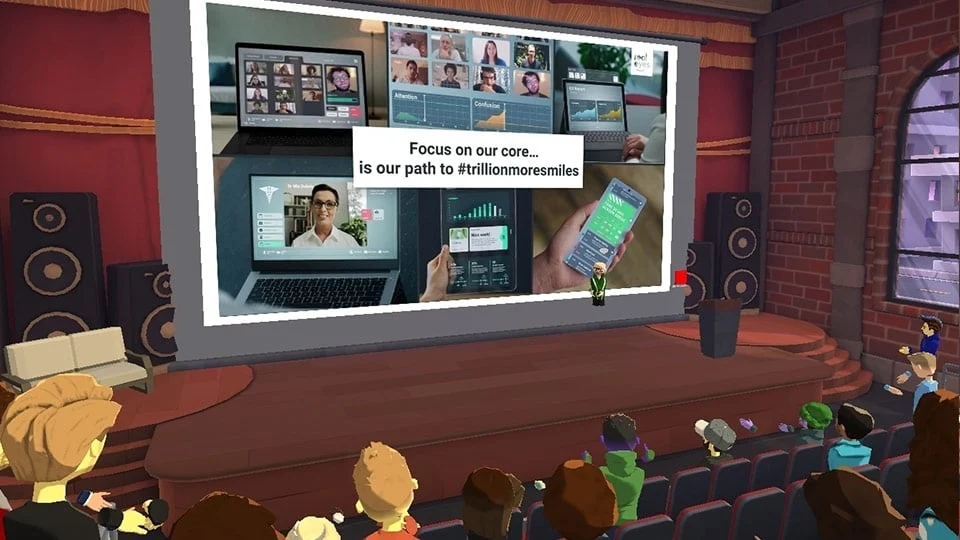
Here’s to a trillion more smiles in 2021!

Navigating the Human and Technical Side of VR
While our virtual offsite was a success, it also highlighted some of the practical hurdles of VR. We learned that programming needs to be broken into shorter sessions to avoid the discomfort that can come with prolonged headset use. This isn’t just an anecdotal observation; it points to a broader conversation about the physical and technical limitations of the current technology. As more companies consider VR for collaboration and training, it’s important to understand these challenges. The experience is powerful, but it requires careful planning to manage the human element and the existing technological constraints that can affect widespread adoption for business use.
Documented Endurance Limits in VR
When we talk about headset fatigue, most people think of eye strain or motion sickness. However, as the technology improves, the primary limitations might be more about general human endurance. For example, a researcher at Penn State Behrend recently spent 55 hours in VR, setting a potential Guinness World Record. He noted that the biggest challenge wasn’t eye strain, but simply staying awake. This suggests that as hardware becomes more comfortable and displays get better, the barriers become less about the tech itself and more about the practicalities of spending extended time in a fully immersive digital environment. For company events, this reinforces the need for scheduled breaks and varied activities to keep participants fresh and engaged.
Broader Challenges to VR Adoption
Beyond physical endurance, a couple of major factors still hinder VR’s universal adoption in the business world. The first is cost. While a $300 headset is much cheaper than an international flight, equipping an entire organization is a significant capital expense. The second challenge is the need for more versatile applications. Right now, many VR apps are built for specific games or social experiences. For businesses to fully embrace the technology, they need a wider range of tools for things like project management, collaborative design, and data visualization. Until the cost comes down and the software ecosystem matures, many companies will likely approach VR as a tool for special events rather than daily operations.
The Science and Expanding Use Cases of VR
Despite the challenges, the reason VR continues to generate so much excitement is its proven effectiveness in a growing number of fields. The technology is moving far beyond gaming and one-off corporate events. Industries where immersive, hands-on experience is critical are finding that VR offers a safe, repeatable, and highly effective way to train and treat people. From healthcare to defense, virtual environments are providing solutions to real-world problems. This expansion is backed by research that shows how VR can fundamentally change the way we learn and process information, making it a powerful tool for skill development and cognitive improvement.
How VR Is Used in Other Industries
The applications for VR are incredibly diverse and often have very high stakes. In medicine, it’s becoming a vital tool for both training and therapy. Surgeons, for instance, can practice complex procedures in a risk-free virtual operating room, refining their skills before ever touching a patient. Beyond training, VR is also used in treatment. A recent study found that VR-based treatments can help children with ADHD significantly improve their attention by providing engaging, focused environments. This ability to create controlled, immersive worlds has made VR an indispensable technology in many sectors.
From Surgical Training to Military Simulations
The medical field is not alone in its adoption of VR. For years, the aviation and military sectors have used sophisticated simulators to train pilots and soldiers for complex, high-pressure situations. VR provides a way to create realistic scenarios that would be too dangerous or expensive to replicate in the real world. This allows trainees to build muscle memory and decision-making skills in a controlled setting. Whether it’s a surgeon learning a new technique or a pilot practicing emergency maneuvers, VR offers a powerful platform for experiential learning that translates directly to real-world performance.
Research Findings on VR’s Effectiveness
So, what makes VR so effective? The key lies in immersion. When a user is fully immersed in a virtual world, their brain processes the experience in a way that is remarkably similar to reality. This creates a distraction-free environment that is ideal for focused learning and skill acquisition. The research into VR’s impact on children with ADHD highlights this well. The study found that fully immersive VR, which completely envelops a user’s senses, was more effective than non-immersive VR experiences viewed on a screen. This suggests that the more believable and engaging the virtual world is, the greater its potential to hold our attention and help us learn.
How Immersive VR Can Help with Focus and Skill Development
The power of immersive VR comes from its ability to command our full attention. By blocking out external stimuli, it allows users to concentrate completely on the task at hand. This is why it’s so effective for both skill development and cognitive therapies. When you’re learning a new skill, this focused state can accelerate the learning process and improve retention. For someone struggling with attention, it provides an environment free of the distractions that disrupt focus in the real world. This principle is the foundation of VR’s success in fields as varied as corporate training, mental health, and education.
The Future of VR Technology in Business
Looking ahead, the virtual environments we use for work are set to become even more realistic and interactive. The technologies that power VR are evolving rapidly, and several key trends are shaping the future of virtual collaboration. The integration of artificial intelligence, the development of haptic feedback systems that simulate touch, and the blending of virtual and augmented reality are all poised to make digital interactions feel more natural and intuitive. These advancements will not only enhance virtual events but could also redefine remote work, training, and creative collaboration for businesses everywhere.
The Rise of AI, Haptics, and Mixed Reality
The next wave of VR will be smarter, more tangible, and more connected to our physical world. Artificial intelligence will make virtual experiences more personal and realistic, with AI-powered avatars and environments that can react dynamically to users. At the same time, advancements in haptics will add a sense of touch, allowing you to feel the texture of a virtual object or the handshake of a colleague’s avatar. Furthermore, the lines between virtual and augmented reality are blurring. Future headsets will increasingly offer mixed reality capabilities, overlaying digital information onto the real world and allowing for seamless interaction between physical and virtual spaces. As these digital worlds become more convincing, ensuring the person behind the avatar is real—not a bot or deepfake—will be essential for maintaining trust, a challenge we at Realeyes are dedicated to solving.
Frequently Asked Questions
Why should my company consider a VR offsite instead of just a multi-day video conference? Think of it as the difference between watching a travel show and actually being on vacation. Video calls are great for transactional meetings, but they can’t replicate the feeling of presence—the spontaneous side conversations or the shared energy of being in the same room. A VR offsite creates a memorable, shared experience where your team can interact in a three-dimensional space, which fosters a much deeper sense of connection and camaraderie than staring at a grid of faces on a screen.
What’s the biggest unexpected challenge we should prepare for when planning our first VR event? Beyond the obvious logistics of hardware and software, the most significant challenge is managing human energy and comfort. We learned that you can’t simply transfer an all-day, in-person agenda directly into VR. “Headset fatigue” is real, so you need to design the event with shorter sessions and frequent breaks. It’s crucial to build a schedule that allows people to step away, grab a drink, and rest their eyes, ensuring the experience remains enjoyable and productive rather than draining.
Do we have to buy a VR headset for every single employee to make this happen? Not at all. While we chose to send headsets to our global team for our multi-day event, it’s not the only option. For a shorter, more focused team-building activity, you can partner with dedicated VR venues that provide all the equipment on-site for a few hours. Alternatively, full-service event companies can manage hardware rentals and logistics for you. The right approach depends entirely on your budget, goals, and the scale of your event.
How do you make a VR event feel genuinely social and not just like a long, technical meeting? The key is to design for interaction. We found that features like “proximity audio,” where you can only hear the avatars standing near you, were incredibly powerful for encouraging natural conversations. We also created unique breakout “rooms”—like a desert island—that felt more like fun destinations than corporate meeting spaces. By building in unstructured social time, games, and visually interesting environments, you give people the freedom to connect in a more relaxed and human way.
Is this technology really ready for a serious corporate event, or is it still just a novelty? It’s absolutely ready, but it requires thoughtful planning. The technology has matured significantly, moving beyond gaming into serious applications for training and collaboration. The success of a VR event doesn’t depend on having the most cutting-edge graphics, but on creating a seamless and engaging experience that achieves your company’s goals. When planned correctly, it’s a powerful strategic tool for bringing a distributed team together in a way that simply wasn’t possible before.