

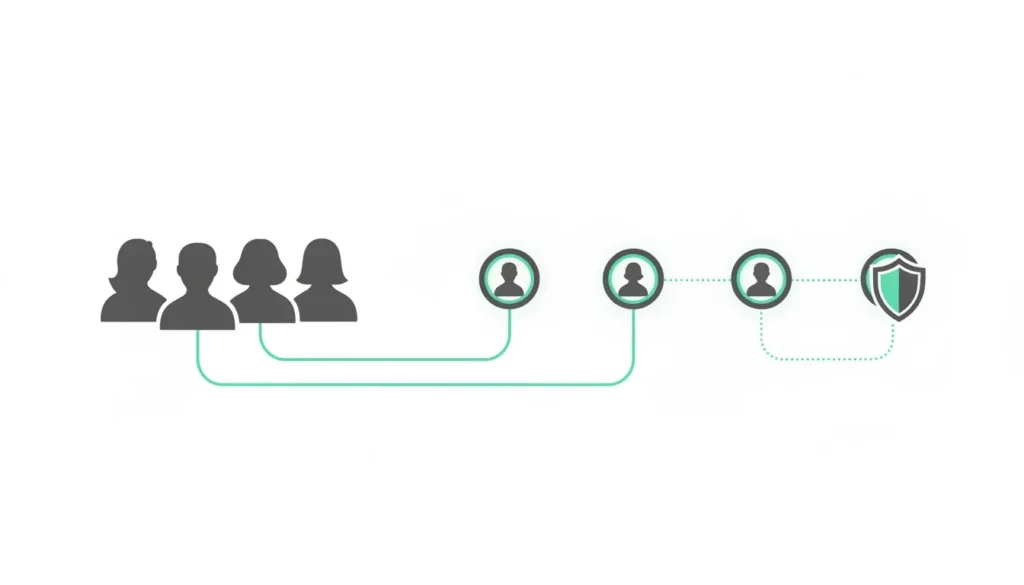
One-person-one-account verification gives a digital platform a way to enforce a simple policy: one real person should not be able to create or control multiple accounts when duplicate participation creates risk. The practical challenge is deciding what the platform actually needs to know. Is a live human present? Is that human unique within the service? Is the person the same one who created the account? Or does the workflow require legal identity evidence?
What Is One-Person-One-Account Verification?
One-person-one-account verification links a permitted account to a unique human signal, then uses that signal in the platform’s account and risk decisions. It is not automatically the same as collecting a legal name, checking a government ID, or making every user complete a document workflow.
The distinction matters because “one account per person” is a policy, not a single technical feature. A platform may use email, phone, device, network, behavioral, payment, and identity signals to find likely duplicates. It then needs a proportionate way to decide whether the match is a genuine duplicate, a legitimate exception, or a case that deserves review.
VerifEye is designed for the human-presence and uniqueness parts of that decision. Its documentation describes liveness detection, uniqueness checks across accounts, one-to-one re-verification, and continuity of control as separate capabilities. That separation is useful: a person can be live and still operate several accounts, while an account can remain associated with the original person even when a password or device changes.
Why Do Platforms Need a One-Person-One-Account Policy?
Multi-accounting becomes a business problem when the platform’s value, incentives, or safety controls assume that each account represents a distinct participant. A duplicate account can distort measurement, consume limited resources, bypass eligibility rules, or give one actor more influence than the product intends.
Common examples include:
- Promotional abuse: one actor repeatedly claims new-user offers or incentives.
- Research and panel contamination: one person appears to be several respondents, weakening the quality of the data.
- Gaming and competition abuse: additional accounts create unfair advantages, manipulate rankings, or move value between profiles.
- Marketplace manipulation: coordinated accounts distort listings, reviews, demand, or seller behavior.
- Community and content abuse: one person uses an account network to evade moderation or amplify activity.
- Fraud and synthetic identity operations: repeated enrollment creates more opportunities to test stolen, fabricated, or compromised credentials.
The objective is not to eliminate every second account in every context. Some products legitimately support family accounts, business roles, test environments, accessibility arrangements, or separate professional and personal identities. The policy should state where uniqueness is required, where exceptions apply, and what happens when the evidence is inconclusive.
Which Signal Does the Platform Actually Need?
Before selecting a verification method, separate the questions. A clean decision model avoids using a costly identity check to answer a smaller question, or assuming that a liveness result proves more than it does.
| Question | Useful signal | What it does not prove |
|---|---|---|
| Is a real person present now? | Liveness or human-presence verification | That the person has only one account |
| Has this person already enrolled? | Uniqueness or one-to-many matching within the platform | Legal name, address, or citizenship |
| Is this the same person as before? | One-to-one re-verification or continuity of control | That the original enrollment was honest |
| Is the person legally identified? | Identity proofing, often with documents or an approved alternative | That the account will never be misused |
| Is the activity risky? | Layered risk signals, rules, and human review | A definitive conclusion from one signal alone |
This distinction is consistent with the OWASP Authentication Cheat Sheet, which treats authentication, identity proofing, and risk-based controls as related but different parts of an identity system. It also aligns with the current NIST Digital Identity Guidelines, which separate identity proofing, authentication, enrollment, and federation requirements.
How Should a Platform Design the Verification Flow?
A useful one-person-one-account flow is a decision system, not a single screen. The following sequence gives product, fraud, and trust teams a practical starting point.
- Define the account rule. Specify the object being limited, the scope of uniqueness, the legitimate exceptions, and the action taken when the rule is breached.
- Map the risk moments. Consider account creation, promotion claims, high-value actions, suspicious login, repeated submissions, account recovery, and moderation evasion. The strongest check does not need to run on every low-risk interaction.
- Collect explicit consent. Explain what the check is for, what signal is produced, how long it is retained, and which decisions it can influence. The answer should be understandable without turning the privacy notice into a technical archaeology project.
- Establish the human signal. Liveness can help distinguish a present person from a photo, replay, deepfake, or automated interaction. It is a foundation for uniqueness, not a replacement for it.
- Apply the uniqueness rule. Compare the relevant signal against accounts already enrolled in the platform’s permitted scope. Keep the output focused on the policy question, such as whether the person has already used the service, rather than collecting unrelated identity attributes.
- Route uncertainty to review. Shared devices, households, account recovery, accessibility needs, and unusual but legitimate behavior can produce duplicate-like evidence. A possible match should create a review path, not an irreversible accusation.
- Measure the result. Track abuse prevented, false positives, appeals, completion, abandonment, review volume, recovery outcomes, and downstream conversion. A control that blocks bad activity but also drives away legitimate users is not finished.
For implementation teams, the VerifEye documentation lays out multiple integration paths, including a hosted redirect flow, SDKs and APIs, and private SDK options. The right choice depends on who controls capture, the platform’s compliance requirements, the required user experience, and the deployment environment.
What Are the Main Implementation Options?
Most platforms use a layered model. Each layer answers a different question and gives the risk engine more context without making a single check carry the entire burden.
Account and contact signals
Email and phone verification can raise the cost of casual account creation, but they are weak proof of uniqueness on their own. A person may control multiple addresses or numbers, and a number can be recycled. Treat these signals as useful context, not as a personhood guarantee.
Device, network, and behavioral signals
Device and network signals can expose clusters of accounts, unusual velocity, repeated workflows, or coordinated activity. They are valuable for detection, but they can also create false positives in shared households, offices, schools, mobile networks, and privacy-conscious environments. Behavioral signals describe activity. They do not, by themselves, establish that two accounts belong to the same human.
Human-presence and uniqueness verification
A privacy-preserving human check can add confidence at enrollment or at a later risk moment. VerifEye describes a single capture that can support liveness, uniqueness, age range, and later re-verification, depending on the configured use case. That can reduce the need to collect documents when the platform needs a human signal rather than legal identity.
Document-based identity proofing
Some regulated or high-consequence workflows need formal identity proofing. Documents may be appropriate when the platform must establish a legal identity or satisfy a specific obligation. They are not automatically the right answer to duplicate-account abuse. Choosing the narrowest control that solves the actual problem can reduce data exposure and user friction.
How Can Platforms Protect Privacy While Enforcing Uniqueness?
Privacy and account integrity are not opposing requirements. The design question is what the platform stores, who can access it, how long it is retained, and whether the decision can be made without exposing a person’s identity to every internal system.
A strong architecture begins with data minimization. Store the result required by the policy, separate it from general profile data where practical, restrict access, define retention, and document deletion and appeal procedures. Do not retain raw captures simply because the system can. Capability is not a retention policy.
Privacy-preserving identity research also points to an important distinction between proving personhood and revealing identity. The paper Personhood credentials: Artificial intelligence and the value of privacy-preserving tools to distinguish who is real online describes credential limits and unlinkable pseudonymity as ways to let a person demonstrate eligibility without making every service interaction traceable to a civil identity. The paper is not a deployment recipe for every platform, but it is a useful reference point for teams balancing uniqueness, anonymity, and abuse resistance.
For a platform evaluating a biometric or human-presence workflow, privacy review should cover consent, purpose limitation, data flows, model performance across relevant populations, access controls, retention, vendor responsibilities, and user recourse. “No document required” is helpful, but it is not a complete privacy story on its own.
How Should Teams Test a One-Person-One-Account System?
A proof of concept should test the policy in the conditions where it will be used, not just whether a clean sample can pass a demo. Build the evaluation around four questions.
- Does it detect the intended abuse? Test repeated enrollment, account farming, coordinated activity, replay attempts, presentation attacks, and recovery scenarios that match the platform’s threat model.
- Does it preserve legitimate access? Include shared devices, varied connectivity, accessibility needs, returning users, and approved exceptions. Record not only pass rates but also unnecessary escalations.
- Can operations act on the result? Confirm that the output reaches the policy engine, review queue, account-recovery flow, and audit trail with clear ownership.
- Can the platform explain the decision? Users and reviewers need a usable explanation, an appeal path, and enough evidence to distinguish a policy decision from a technical failure.
Set a baseline before the test starts. Measure duplicate-account rate, abuse loss, review workload, completion, abandonment, account recovery success, and time to decision. Then compare the verification flow against the existing control rather than against an idealized zero-risk world.
Sources and Further Reading
- NIST SP 800-63-4, Digital Identity Guidelines, for identity proofing, authentication, enrollment, and federation.
- OWASP Authentication Cheat Sheet, for authentication, automated attack protection, reauthentication, and risk-based controls.
- Personhood credentials, for privacy-preserving approaches to proving personhood and limiting scalable deception.
- VerifEye documentation, for liveness, uniqueness, re-verification, continuity of control, and integration paths.
Frequently Asked Questions
What does one-person-one-account verification prove?
It can give a platform confidence that an account is associated with a unique human within the platform’s defined scope. It does not automatically prove a legal name, citizenship, address, or eligibility.
Is liveness detection enough to prevent duplicate accounts?
No. Liveness helps establish that a real person is present at the time of the check. A separate uniqueness decision is needed to determine whether that person has already enrolled or controls another account.
Does one-person-one-account verification require a government ID?
Not always. If the platform needs a human-presence or uniqueness signal rather than legal identity proofing, a privacy-preserving verification flow may be sufficient. Regulated or high-consequence use cases can still require documents or another approved identity method.
When should a platform run the check?
Common points include account creation, promotion claims, suspicious activity, high-value actions, repeated submissions, account recovery, and access to regulated or age-restricted experiences. The right trigger depends on the consequence of failure and the cost of added friction.
How should platforms handle a possible duplicate?
Route uncertain matches to a reviewable decision with clear reasons, legitimate exceptions, and an appeal path. Shared households, common devices, accessibility needs, and account recovery can create duplicate-like signals without proving abuse.
Verify real humans. Without the friction.
VerifEye confirms users are real and unique in seconds. No documents, no stored data, no drop-off.