

VerifEye — Human Verification Layer
VerifEye is a privacy-first human verification platform that confirms a real, live, unique person is present in real time. No identity documents, codes, or specialist hardware required.
How it works
VerifEye combines presence, liveness, uniqueness, and age estimation into one reliable result: a real, unique person is present right now.
VerifEye combines four signals to produce a single, reliable result: there is a real, unique person present right now.
Signal 1
Confirms a person is present at the point of verification.
Signal 3
Matches the person to their verified identity, preventing duplicate accounts and confirming they’re who they claim to be for logins, transactions, or access.
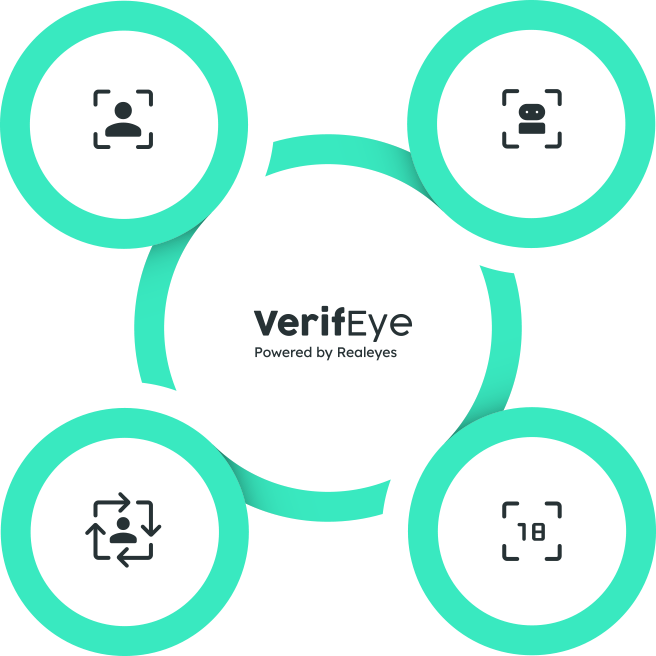
Signal 2
Detects whether the person is live, rather than a bot, photo, video, or spoof.
Signal 4
Estimates age without requiring an identity document.
Onboard. Reverify. Protect. Recover. One human layer.
The same human, confirmed over time
Step up exactly when risk spikes
Safe recovery, no weak links
Privacy by design
Unlike traditional identity verification vendors that store biometric templates and sensitive identity documents in centralized databases, VerifEye was purpose-built around privacy-by-design principles from day one. No biometric data is retained after the verification event — only an anonymized signal confirming human presence. This architecture eliminates the data breach risk, compliance burden, and user privacy concerns that plague document-based approaches.
For enterprises operating under GDPR, CCPA, or emerging AI governance frameworks, this distinction matters. Document-storing vendors must maintain complex data protection programs, undergo regular audits, and manage data subject access requests. VerifEye’s privacy-first architecture means there is simply no sensitive data to protect or manage — the biometric signal is processed on-device and never stored. The result is a verification layer that meets the highest privacy standards without any of the operational overhead.
Confirmation happens in the moment. Nothing is retained between sessions unless the application explicitly requires continuity
Your platform receives a verification signal, not personal data. Realeyes never sees who your users are.
Designed to meet regulatory requirements across 180+ markets without legal complexity for your team.
Does
Does not
How platforms use VerifEye
From the moment someone joins your platform to every high-stakes action they — or their AI agents — take afterwards. One integration, continuous coverage.
01
Anchor every new account to a verified human at sign-up. The foundation that makes every subsequent check reliable.
02
Quietly re-confirm the same real human is present throughout a session — without asking them to prove it again.
03
Step up when risk spikes. Confirm a real, consenting human is authorising the action — whether that’s a person or an AI agent acting on their behalf.
04
Face-based recovery closes the vulnerabilities in SMS codes, email links, and support desk callbacks — the weakest points in any account security model.
How platforms use VerifEye
Step 1
Few seconds, no image stored
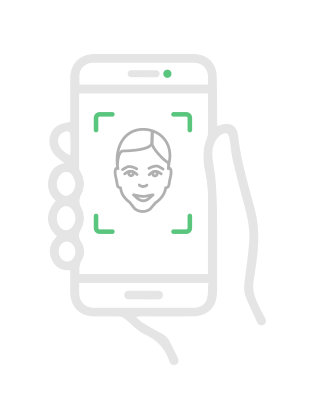
Step 2
Unique, privacy-safe & light (512 bytes)

Step 3
Linked to device, document, credit bureau, behaviour
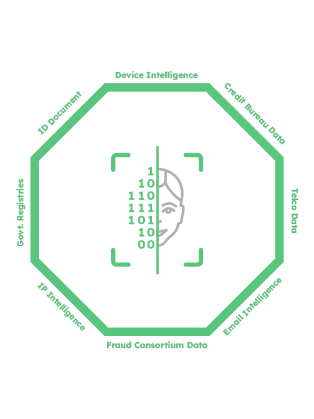
Step 4
Portable & reusable anywhere

Works with your existing stack
Turn selfies or document images from any IDV provider into face credentials that you own and control. No rip and replace. VerifEye converts and stores other vendors’ images as cryptographic embeddings — making every previously verified user reusable.
Or simply run a 3-second selfie check as an account upgrade. Either way, your existing verified user base becomes the starting point for ongoing verification.
Works alongside Jumio, Onfido, Veriff, and any other KYC provider already in your stack.
Convert your verified user base into face credential holders — enabling ongoing verification at scale
From any IDV provider
Fetched via API and sent to VerifEye
Encrypted embedding
Frequently asked
Can’t find what you’re looking for? Talk to the team.
VerifEye turns biometric data into non-biometric. It processes the signal needed to confirm human presence in the moment and converts it into a verification signal; the source biometric is discarded. No biometric data is retained between sessions unless the application explicitly requires continuity. For example, to enable the Uniqueness check that confirms this is the same person, whether that’s blocking a duplicate account or matching them to their identity at login or a transaction.
What your platform receives is a verification signal, not personal data. Realeyes never stores or shares biometric data. We never see who your users are.
VerifEye is designed to meet GDPR requirements by default. Processing happens on-device where possible, minimising data transmission. Where server-side processing is required, data is processed under strict retention limits and is not used for any purpose beyond the verification check.
Realeyes is headquartered in Europe and has operated under GDPR since its introduction. We support compliance documentation for legal teams and cover 180+ markets globally.
VerifEye is available as an SDK for native mobile and web applications, and as an API for server-side integration. Most platforms use the SDK — it handles the camera interface, the verification logic, and returns a signed result to your backend. Integration typically takes days rather than months.
No specialist hardware is required. VerifEye works on any device with a standard front-facing camera.
Liveness detection is one of the three core signals VerifEye runs on every check. It distinguishes a real human from a photo, a video replay, a 3D mask, and AI-generated deepfake content. Realeyes has been pioneering hyper-scale Vision AI since 2007 and trains on one of the largest in-the-wild biometric datasets in the industry.
Detection accuracy is 99.7% across real-world conditions. We maintain and retrain models continuously as spoofing techniques evolve.
Document verification confirms that a document is real and that a person matches it. VerifEye confirms that a real, unique human is present — without a document. These are different problems.
Document verification is the right tool when you need to establish legal identity. VerifEye is the right tool when you need to confirm human presence — at login, mid-session, at a high-value transaction, or at recovery. Most platforms eventually need both layers, and VerifEye sits beneath the document check as the ongoing human signal that persists long after onboarding.
VerifEye requires a camera for the face-based verification check. In practice, virtually all modern smartphones and laptops include a front-facing camera. For platforms where camera availability is genuinely uncertain, VerifEye can be configured as a step-up check rather than a gate — applied at high-risk moments rather than universally, which also reduces friction for the majority of users.
VerifEye can mint a face credential — a verified proof of human presence — that lives in a user’s digital wallet under W3C Verifiable Credentials, ISO mDL, and EUDI wallet standards. Think of it as Face ID that verifies the human, not just the device.
This means a user verified once on one platform can carry that credential to others, without repeating the verification process. It’s the infrastructure layer that makes portable, reusable human identity possible across the open web.
A human verification platform confirms that a real person is present and can add signals such as liveness, uniqueness, and age estimation. VerifEye does this without requiring an identity document, helping platforms reduce bots, duplicate accounts, and fraud while keeping verification low-friction. Explore our human verification solutions.
A human verification platform confirms that a real person is present and can add signals such as liveness, uniqueness, and age estimation. VerifEye does this without requiring an identity document, helping platforms reduce bots, duplicate accounts, and fraud while keeping verification low-friction. Explore our human verification solutions.