

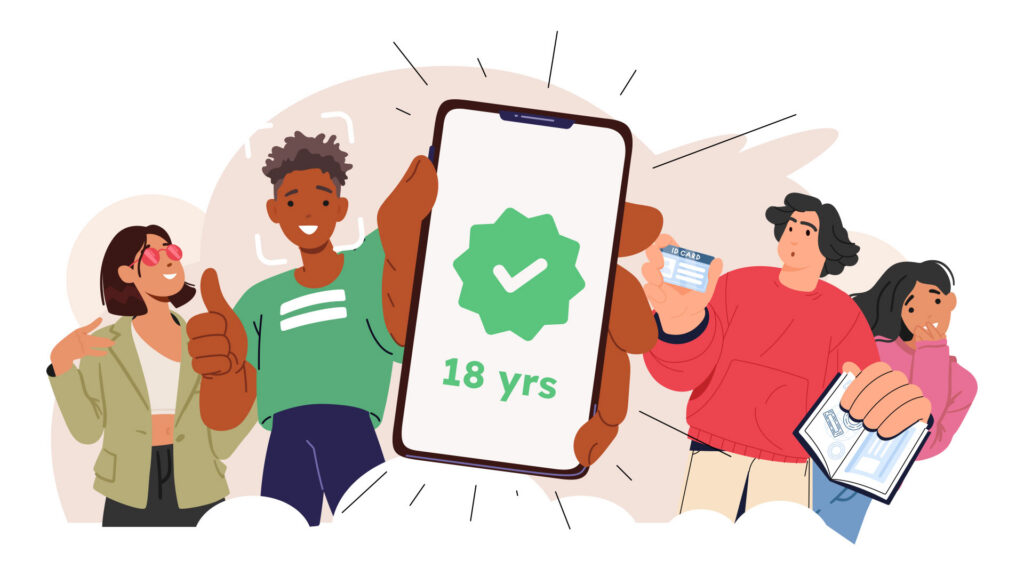
Age verification without ID helps platforms confirm whether a user meets an age threshold without forcing every person to upload a passport, driver’s license, or other government document. For enterprise teams, the value goes beyond convenience: document-free age assurance reduces signup friction, limits sensitive data exposure, and supports current online safety and privacy expectations — when it’s built with consent, accuracy, fairness, accessibility, and auditability in mind.
Need document-free age checks for your platform? Try a VerifEye demo to see how Realeyes verifies age, liveness, and uniqueness without asking every user for a government ID.
Every additional document you ask for is a user you don’t get. Age verification is the one compliance requirement most likely to cost you the very users you’re trying to protect.
Key Takeaways
- Ditch the ID check for a better approach: traditional ID verification creates unnecessary friction and security risk. Modern methods confirm age without collecting sensitive documents.
- Verify an attribute, not an identity: the goal is answering “is this user over 18?” — not knowing who the user is. That minimizes data collection by design.
- Choose the right tool for the job: the best method depends on your industry, risk level, and user base, balancing security with a seamless experience.
Is Age Verification Without an ID Possible?
Yes. Platforms can estimate whether a user meets an age threshold without ever collecting a government document. The right method depends on jurisdiction, risk level, and audience, but the technology has matured enough that “document or nothing” is no longer the only option. For years the default was to ask for a government ID. That doesn’t scale: it’s expensive, it excludes people who don’t have ID handy, and it asks users to hand over far more data than the question actually requires. Three terms get used almost interchangeably here, so it’s worth being precise:
- Age verification confirms an exact age against an official document — the most stringent and most data-hungry approach.
- Age assurance answers a narrower question: does this user meet a threshold (13, 18, 21), without needing their exact birthday.
- Age estimation is the technology that makes privacy-first assurance possible — AI analyzes a selfie or short video and predicts an age range, without trying to identify who the person is.
For enterprise teams, trust isn’t just a UX issue. VerifEye is built around explicit opt-in consent, no recorded or retained images during service, GDPR-compliant training data, SOC 2-certified controls, and a PwC-audited historic record.
Why Traditional ID Checks Fall Short
Asking for a government ID doesn’t just add friction — it takes on liability. Every uploaded document is sensitive data a platform now has to store and defend, which makes it a target. It’s also expensive: manual checks commonly run around $1.50 each, a cost that compounds at scale.
And it excludes people. Roughly 850 million people globally lack a government-issued ID, and that’s not just a developing-world problem — it includes teenagers too young to drive, the roughly 11% of US adults without a license, and anyone who’d rather not hand over a scan of their passport to sign up for an app. Self-certification checkboxes solve the friction problem but offer essentially no protection, since they’re trivial to lie on.
AI age estimation splits the difference: platforms get a real signal — 95-99% accuracy on over/under-18 determinations, delivered in seconds — without the cost or the exclusion.
Six Ways to Verify Age Without an ID
- AI facial age estimation — analyze a selfie or short video to estimate an age range. VerifEye combines age estimation with liveness and uniqueness checks in one low-friction flow.
- Financial and payment data — banks and card issuers already verify age at account opening; a transaction or secure login can serve as a proxy without exposing other personal data.
- Mobile carrier records — many carriers age-verify before disabling parental controls; a platform can confirm that signal without ever seeing the underlying proof.
- Reusable digital ID tokens — a one-time verification produces a credential a user can present elsewhere, answering “over 18?” without exposing name or birthdate each time.
- Database cross-checks — matching name, address, and date of birth against credit bureau or public records returns a yes/no without the user uploading anything.
- Parental consent — for under-13 platforms, verify the parent instead of the child, satisfying COPPA without asking a minor for ID.
The goal is never to know who someone is. It’s to answer one narrow question: ‘are they old enough?’ Then forget everything else.
How AI Age Estimation Actually Works
An AI model trained on a large set of facial images learns to associate patterns: skin texture, jawline shape, the area around the eyes, with age ranges, then applies that pattern-matching to a new selfie in real time. It isn’t identifying anyone; it’s estimating how old a face appears.
Top systems reach 95-99% accuracy on threshold questions like “is this person over 18?” – often outperforming a human guessing from an ID photo. Because no system is perfect, most build in a confidence buffer: to clear an 18+ gate, a user might need to appear at least 20, which cuts the risk of a false accept without meaningfully increasing false rejections for legitimate adult users.
Liveness detection is the piece that keeps this trustworthy — confirming a real person is in front of the camera, not a photo, video, or deepfake. And because the image is processed and then discarded, the platform ends up with an anonymous result — an age band, a pass or fail — rather than a stored photo it now has to protect. Realeyes trains on globally representative, consented datasets, including 6M+ participants across 93 countries, to support fairer performance across demographic groups.
Privacy by Design: Minimize What You Collect
The safest data is the data never collected. A well-built age-estimation flow follows that principle end to end: request explicit consent, analyze only what’s needed to answer the threshold question, discard the image, and retain only the result. Done this way, a platform can prove a user meets an age requirement without ever building a database of faces, birthdates, or documents — the strongest privacy posture and the smallest breach surface available. Read more on how online age verification works end to end.
Staying Compliant: COPPA, GDPR, and the UK Online Safety Act
Document-free methods can support compliance, but they’re not a blanket legal guarantee — every deployment still needs jurisdiction-specific review. Three frameworks come up most often:
- COPPA governs any US-facing site that could be used by under-13s; it requires verifiable parental consent before collecting a child’s personal information.
- GDPR (and equivalents like Brazil’s LGPD and California’s CCPA) sets a high bar for processing biometric data specifically — consent must be explicit, and collection must be minimized.
- The UK Online Safety Act puts a duty of care on platforms to keep minors from harmful content, and treats simple self-declaration age gates as no longer sufficient. The common thread: transparency and data minimization satisfy regulators and users at the same time. Explaining plainly what’s being checked and why, and then actually deleting what isn’t needed, does double duty as both compliance strategy and trust-building.
The Real Trade-Offs
Moving off ID checks doesn’t remove every hard problem, it changes which ones you’re solving:
- Privacy vs. accuracy: the more tightly you minimize data collection, the more you’re relying on the model alone to get the call right. Combining age estimation with liveness and uniqueness checks, rather than any single signal, is what closes that gap.
- Bias: a model is only as fair as its training data. Systems trained on narrow datasets are demonstrably less accurate for some demographic groups, which is a fairness problem and a compliance one — ask any vendor directly how they source and diversify training data.
- Cost vs. accuracy: cheap, low-accuracy tools create false economy. A missed underage user is a compliance failure; a wrongly blocked adult is lost revenue.
The platforms that get this right won’t be the ones with the strictest gate. They’ll be the ones that answer one question: old enough, yes or no and let everything else go.
Why VerifEye
Rather than rounding up other vendors, here’s what actually differentiates VerifEye for teams evaluating this space:
- Proven at hyperscale — VerifEye already runs in production for platforms operating at enormous scale, including Meta, which calls the API thousands of times per second. That’s live traffic today, not a roadmap claim.
- Ethically sourced training data — models are trained on consented, paid-participant datasets rather than scraped images — an ethical stance and a fairness advantage across skin tones and demographics.
- Privacy-first architecture — on-device and on-premise deployment options mean biometric data doesn’t have to leave a customer’s environment at all — a stronger posture than a promise to delete it later.
- Independently verified controls — SOC 2-certified controls and a PwC-audited historic record back the compliance claims, rather than asking enterprise buyers to take them on faith.
- 31 patents protecting the underlying technology, plus configurable friction levels so platforms can tune the age check to their actual risk level instead of a one-size-fits-all flow.
Request a demo to see how this fits your platform’s flow.
Which Method Is Right for You
There’s no universal answer, the right method depends on industry risk (a gaming platform and an alcohol retailer face different bars), how much friction your users will tolerate, and what a regulator will expect you to show if asked. Most mature implementations layer methods: AI estimation as the primary low-friction check, with a document or database fallback for edge cases where confidence is low.
FAQs About Age Verification Without ID
Can you verify age online without a government ID?
Yes. Facial age estimation is the most common approach, but the right method depends on the use case, risk level, local rules, and whether you need an age range, a threshold result, or a higher-assurance fallback.
Is facial age estimation the same as identity verification?
No. Age estimation answers “how old does this person appear?” without trying to determine who they are. Identity verification matches a person to a document or account record — a different task with different privacy implications. What happens to my selfie after the check? In a privacy-first flow, the image is analyzed and then immediately discarded. The platform keeps only the result — an anonymous confirmation that the age threshold was met — not the photo.
How should platforms evaluate a vendor?
Look past the headline accuracy number: liveness detection, fraud resistance, fairness across demographic groups, privacy architecture, auditability, integration effort, and available fallback paths all matter more in practice than a single accuracy stat.
Does this guarantee compliance?
It can support compliance when implemented carefully, but it isn’t a universal legal guarantee. Regulators care about accuracy, robustness, fairness, accessibility, data protection, and transparency — documentfree methods should be reviewed by qualified counsel for the specific jurisdiction and use case. See what AI age verification is and isn’t for a deeper look at the trade-offs. The Future: Layered, Reusable, User-Controlled The next step isn’t a single better snapshot — it’s combining multiple low-friction signals (facial estimation, behavioral cues, reusable credentials) into one confident picture, and increasingly putting the credential itself in the user’s control via digital ID wallets, so age gets proven once and reused everywhere.
Related Articles ● How Online Age Verification Works: A 5-Step Guide ● 6 Best Online Age Verification Services for 2025 ● Third-Party ID Verification: A Complete Guide ● What Is AI Age Verification? A Complete Guide Ready to evaluate document-free age assurance for your platform? Talk to Realeyes about age assurance.
Related Articles
- How Online Age Verification Works: A 5-Step Guide
- 6 Best Online Age Verification Services for 2025
- Third-Party ID Verification: A Complete Guide
- What Is AI Age Verification? A Complete Guide
Ready to evaluate document-free age assurance for your platform? Talk to Realeyes about age assurance.