

Technical Whitepaper
Face verification systems are increasingly used for identity verification, access control, fraud prevention and digital onboarding. But evaluating a face verification solution requires more than a headline accuracy number. Organisations need to understand false match rates, performance under real-world conditions, deployment requirements, and resilience against spoofing and synthetic media attacks.
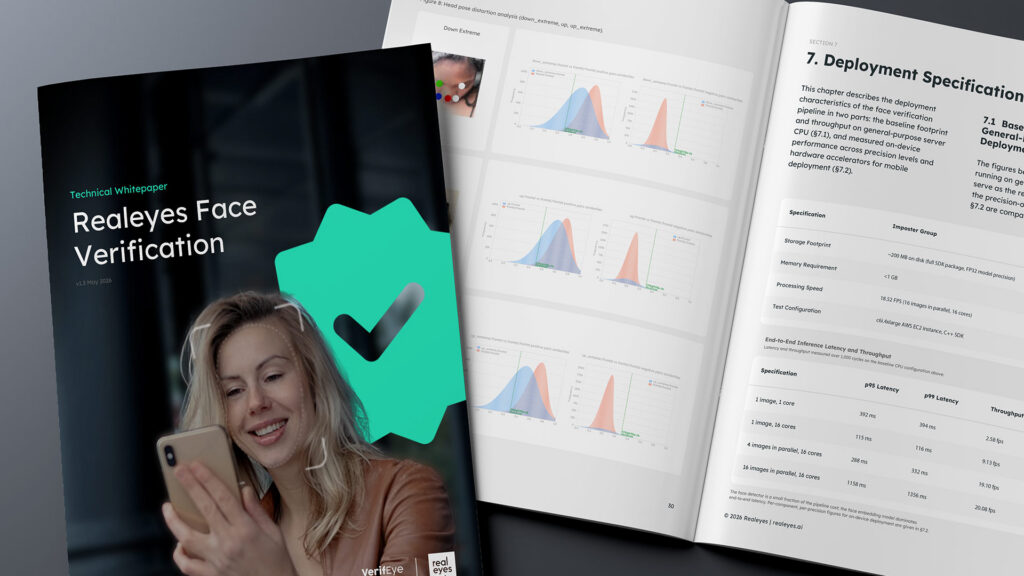
This technical whitepaper provides a detailed look at the Realeyes Face Verification platform, including benchmark results, robustness testing, deployment specifications and advanced security capabilities.
What you'll learn
- How face verification differs from face identification and biometric authentication
- Accuracy benchmarks across millions of face-image comparisons
- Performance under real-world conditions including blur, compression, occlusion, eyewear and extreme head poses
- False positive and false negative rate analysis
- Deployment options for cloud, server and mobile environments
- On-device performance across Android and iOS hardware
- Liveness detection, presentation attack detection and deepfake detection capabilities
- Best practices for building secure, scalable face verification workflows
Why this matters
Many biometric systems perform well under ideal conditions but degrade significantly when faced with poor image quality, facial occlusions or challenging capture environments. This whitepaper examines how a production-grade face verification pipeline behaves under realistic operating conditions and explains the engineering trade-offs involved in achieving both security and usability.
Whether you’re evaluating biometric authentication, customer onboarding, workforce verification or secure access control, this guide provides the technical detail needed to make informed decisions.