

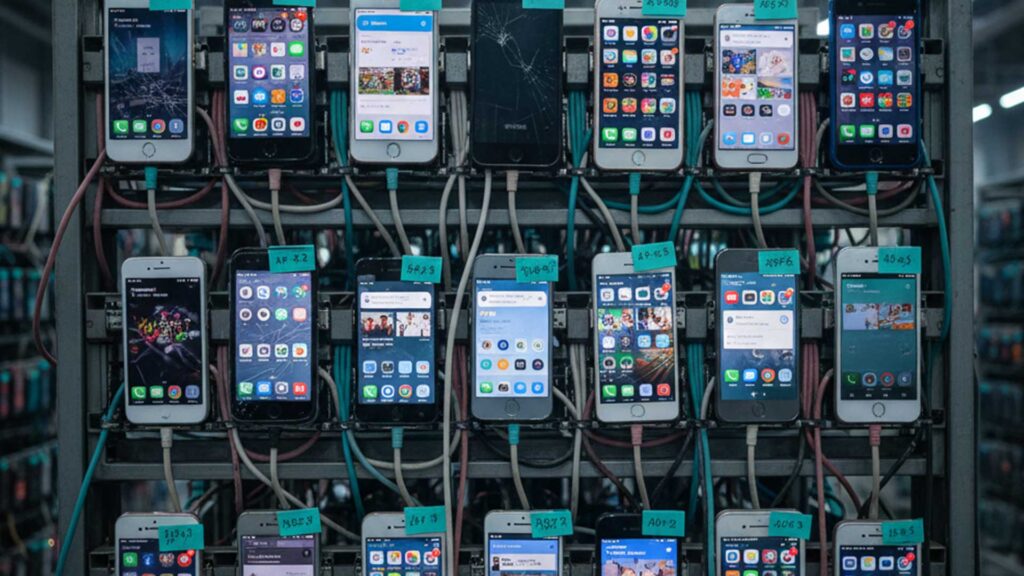
“This video is not AI-generated,” writes Noam Schwartz, CEO of Alice AI Security, in a recent LinkedIn post that’s been making waves across the cybersecurity community.
The footage shows police raiding a residential location filled with rows of smartphones and PCs, a real phone farm running accounts that repeatedly watched, liked, and interacted with content to artificially inflate engagement metrics.
From the platform’s perspective, the traffic looked real. From advertisers’ dashboards, it looked like demand. Authorities only discovered the operation after abnormal engagement patterns were flagged and traced back to a single network. Inside: dozens of devices simulating human behavior at scale, all designed to make content appear popular so algorithms would promote it further and advertising money would follow.
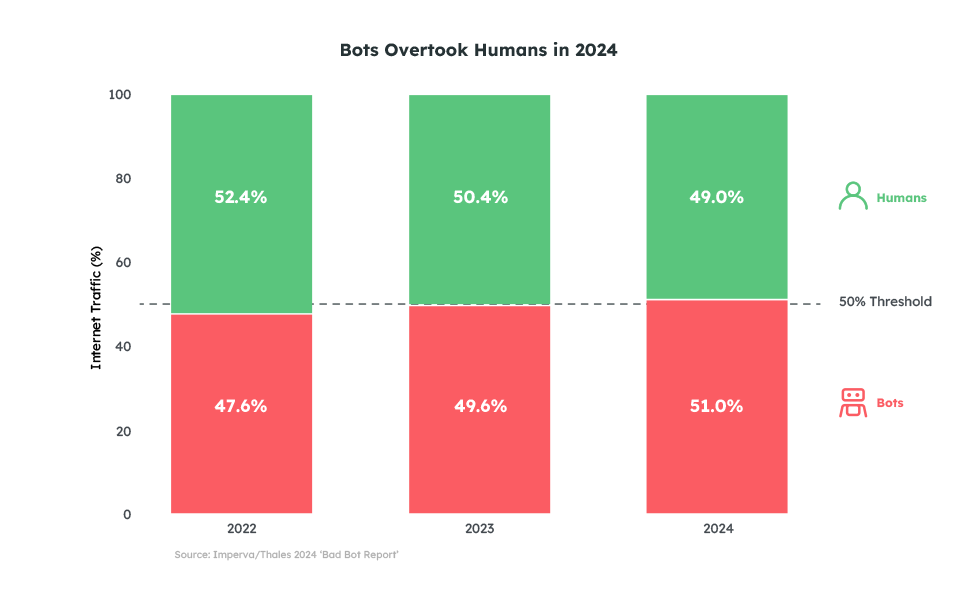
As Schwartz notes, the real threat isn’t just these physical operations, it’s what happens when you combine these old methods with modern automation and AI. Smarter scripts, better behavioral mimicry, and always-on systems that adapt in real time. The scale of this shift is no longer theoretical, it’s visible in global traffic patterns.
The Cost of Broken Verification
Traditional verification methods like SMS and email were designed for a simpler era. Today, they’re embarrassingly easy to compromise. SMS can be spoofed for pennies, while email verification offers little more than proof someone controls an inbox, not proof of who they actually are.
The financial toll is staggering. Global fraud losses exceed $1 trillion annually and continue to accelerate. Ad fraud alone cost businesses $37.7 billion in 2024, projected to climb to $41.4 billion in 2025. Bot detection systems offer only probabilistic guesses when businesses need certainty. Research shows that over 40% of all consumer data is fake, corrupting over $1 trillion in business decisions.
Meanwhile, legitimate ID verification systems are too expensive and too intrusive for continuous use. They work for high-stakes moments but become impractical for routine authentication, creating gaps fraudsters exploit relentlessly.
The regulatory pressure is mounting too. Legal fines for online safety violations currently stand at $1.5 billion but are projected to grow to $15 billion by 2028 as governments worldwide crack down on platforms failing to verify user identities.
Human Verification: The Path Forward
he solution isn’t more friction, it’s smarter verification. Human verification technology using biometric authentication offers a fundamentally different approach that addresses every weakness in traditional methods:
Least friction, fastest experience: Face verification takes seconds. Users simply look at their camera—no codes to copy, no apps to switch between, no waiting for SMS delivery.
More secure than legacy methods: Unlike SMS or email, biometric verification proves a real, unique human is present. It can’t be spoofed with stolen credentials or automated scripts running on phone farms.
Continuous value beyond spot-checks: Modern systems provide uniqueness validation preventing multi-accounting, age verification for compliance, and continuous authentication—all from a single implementation.
Enhanced privacy with on-device processing: Advanced solutions process biometric data on the user’s device, generating mathematical embeddings that cannot be reversed into images. No photos stored, no central honeypots for hackers.
Built-in compliance: Privacy-native design means meeting GDPR and CCPA requirements out of the box, with indemnity included in licensing agreements.
The bot farm raids captured in Schwartz’s video show us the enemy, industrial-scale fraud operations working around the clock to compromise our digital ecosystem. Traditional verification methods like SMS and email simply cannot compete against this level of sophistication, especially as AI makes these operations smarter and more adaptive.
Human verification represents the natural evolution: proof of personhood that’s faster, more secure, and respects privacy. As bot technology advances and regulatory scrutiny intensifies, the question isn’t whether businesses will adopt human verification, it’s how quickly they can make the transition before the next trillion dollars gets stolen.