


Celebrity impersonation is the deceptive use of a public figure’s name, image, voice, likeness, or account identity to create a false impression of authenticity. It may be harmless entertainment when clearly labeled. It becomes abusive when the borrowed identity misleads people, damages reputation, manipulates engagement, or solicits money or access.
The operational distinction is disclosure and intent. An impressionist identifies the performance. A scammer presents a borrowed identity as genuine and uses that deception to influence a decision. That makes the issue more than a content-moderation problem. It is an identity-authenticity problem involving the person represented, the person operating the account, and the audience being asked to trust it.
Verification badges and follower counts can provide useful context, but neither proves that the current operator is the person represented. A practical defense combines provenance, behavioral signals, user reports, media analysis, human review, and privacy-preserving checks for human presence and uniqueness. These are the same layers VerifEye’s Protect and Reverify applications are built around: confirm a real, unique human is present, not just match a face to a photo.
Why Is Celebrity Impersonation a Platform Trust Problem?
Celebrity impersonation is a platform trust problem because a public figure’s reputation can transfer credibility to a fraudulent account, message, endorsement, or payment request. The platform supplies the audience and distribution. The attacker supplies a borrowed relationship. Effective controls must protect fans and public figures while preserving legitimate parody, agency workflows, and ordinary conversation.
The immediate harm may be financial. A fake account can request a gift card, cryptocurrency transfer, investment deposit, or payment for an exclusive opportunity. Other attacks seek credentials, personal information, or a move to an encrypted channel where the platform has less visibility. The request works because the target is not evaluating an unknown seller. The target believes a familiar person is speaking directly to them.
The wider damage is distributed across the ecosystem. Fans lose confidence in the platform’s ability to distinguish a real account from a convincing spoof. Public figures and their representatives may have to correct fraudulent endorsements or statements. Legitimate creators can see their audiences diverted. Trust and safety teams must investigate profiles, sessions, messages, payment destinations, and connected accounts.
AI-generated voice and video add persuasive material to the attack. The Federal Trade Commission has warned that AI-generated deepfakes could intensify impersonation fraud. The technology does not need to be perfect. It only needs to create enough confidence for someone to act before checking the source.
This is distinct from fake brand account detection. A brand spoof borrows organizational identity. A celebrity spoof borrows a perceived personal relationship. That difference affects the evidence, the user experience, and the response path.
How Do Celebrity Impersonation Scams Work on Social Media?
Celebrity impersonation scams usually move from a public signal to a private request. The attacker copies identity cues, establishes familiarity, transfers the public figure’s credibility, creates urgency, and then moves the target toward money, credentials, or another channel. The sequence is useful for detection because each step creates signals a platform can measure.
- Contact: A reply, story reaction, follow, or direct message creates a sense of personal access.
- Familiarity: Recent posts, private-looking images, shared interests, or sympathetic details make the exchange feel plausible.
- Trust transfer: The public figure’s reputation supports an offer, endorsement, charity request, investment claim, or meeting invitation.
- Urgency: A limited opportunity, emergency, exclusive access claim, or threat of lost access discourages careful checking.
- Conversion: The conversation moves to a payment app, wallet, gift card, external form, or encrypted messaging service.
Profile Cloning and Lookalike Handles
Profile cloning is the simplest version. An attacker copies a profile photo, biography, recent posts, and follower-facing language. The handle may differ by one character, punctuation mark, extra word, or substituted letter. On a small screen, that difference can disappear into the surrounding interface. A cloned account can also reply beneath posts from the genuine profile, using proximity as a credibility signal.
Detection should compare account age, handle history, linked profiles, claimed contact points, posting patterns, and the relationship between the account and the public figure’s known channels. None of these signals should be treated as conclusive on its own. A parody account, fan account, agency account, and malicious clone can share surface features.
Account Takeover and Delegated Access
Account takeover uses an established account rather than creating a copy. Stolen credentials, phishing, session-token theft, or a compromised recovery channel can give an attacker control of a real profile. The existing handle, audience, and history do much of the persuasion. A sudden change in direct-message volume, payment destinations, posting cadence, or access geography may be the first visible sign.
Delegated publishing makes the distinction more difficult. Public figures may use agencies, managers, production teams, or regional staff. A sound system records authorized access and expected workflows instead of treating every new device or location as proof of abuse. It should identify unexplained changes while allowing legitimate teams to work. This is the role Reverify plays: it keeps confirming the same human controls the account over time, so a real handoff to a new team member reads differently than a stolen session.
Synthetic Media as Supporting Evidence
Generated voice, video, and images can reinforce an impersonation narrative. A clip may be presented as proof of identity while automated messages keep many conversations moving. Media analysis can identify manipulation, but it cannot answer every identity question. A genuine video can still be posted by an unauthorized account, and an authentic account can still be hijacked.
That is why media authenticity and account authenticity should remain separate decisions. Platforms should connect them with provenance, behavior, session context, reporting, and human review. The result is less theatrical than a single magic detector, but considerably more useful in production.
What Signals Separate a Real Public Figure from a Spoofed Account?
No single badge, face match, or follower count can establish account authenticity. Platforms should compare several independent signals, including provenance, behavior, session context, media, reports, liveness, and uniqueness. When those signals disagree, the right response is proportionate review or step-up verification, not an automatic verdict that may punish legitimate teams or parody.
Provenance and Account History
Provenance asks where an account came from and whether its identity has a consistent record. Useful evidence can include account age, prior handle changes, linked profiles, authorized ownership records, known representatives, and the continuity of content. An unexplained change in name, language, location, posting cadence, or audience matters more when it appears alongside a new money or credential request.
The objective is not to penalize a public figure for changing managers or strategy. It is to distinguish a documented transition from an unexplained break in identity continuity. Platforms should make delegated publishing possible while keeping authorization auditable.
Behavioral and Session Anomalies
Behavioral signals add context that a static profile cannot provide. A profile operating outside its historical norm may suddenly send high volumes of direct messages, promote one payment funnel to unrelated fans, or target people who recently engaged with the real figure. Repeated login failures, unfamiliar device fingerprints, impossible travel patterns, session overlap, and abrupt geography changes can indicate takeover or coordinated activity.
These signals should raise a risk score, not serve as automatic proof. Public figures travel, use agencies, and publish through teams. The system should record why an intervention occurred and give reviewers enough context to separate legitimate delegation from abuse.
Human Presence and Uniqueness
Reports often supply the first evidence of a convincing spoof. A useful report preserves the profile URL, message, payment request, impersonated identity, and relevant timing rather than only flagging a post. Platforms can combine this evidence with liveness and uniqueness checks.
Liveness helps establish that a live person is present during a verification event instead of a replay or synthetic presentation. Uniqueness helps determine whether one person appears to operate multiple supposedly distinct identities in a coordinated pattern. These checks address the human behind the account, not merely its popularity. In VerifEye’s application model, this is Onboard anchoring a real, unique human at account creation, and Protect stepping up to an unfakable check the moment risk spikes.
For broader account protection context, teams can review account spoofing and fraud prevention controls. For manipulated media, the deepfake detection API guide provides a related technical angle. The topics overlap, but neither replaces a layered identity decision.
How Can Platforms Detect Celebrity Impersonation at Scale?
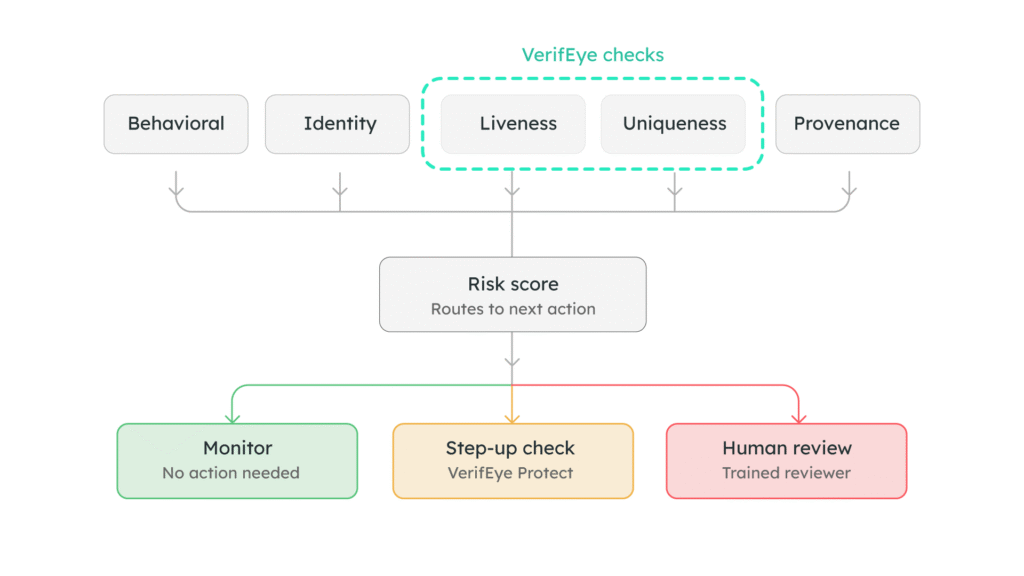
Platforms detect celebrity impersonation at scale by combining account, content, session, identity, and report signals into a risk-based workflow. The score should determine the next action, from monitoring to a step-up check or human review. This layered design is more resilient than relying on a badge, a facial match, or a single media detector.
Risk-based detection flow, with liveness and uniqueness checks tied to VerifEye Onboard and Protect:
| Signal | What It Reveals | Limitation |
|---|---|---|
| Behavioral | Changes in posting, messaging, destinations, payment requests, or audience targeting. | Viral moments, campaigns, and takeovers can look similar without context. |
| Identity | Whether claimed names, images, voices, and identifiers align with reliable evidence. | Public information can be copied, manipulated, or stale. |
| Liveness | Whether a live person is present during a verification event. | Presence at one moment does not explain every later action. |
| Uniqueness | Whether one person appears to operate multiple identities in coordination. | Households, agencies, and shared environments can create legitimate overlap. |
| Provenance | Whether ownership, content, and authorization trace to a credible source. | Evidence may be incomplete, and official channels can be compromised. |
| Human review | Whether reviewers can interpret intent, authorization, and reports. | Review takes time and requires consistent calibration. |
Use Risk Scoring and Step-Up Checks
Signals should feed a layered risk score rather than an automatic verdict. A new account using an exact celebrity handle, sending high-volume messages, and directing fans to an unfamiliar payment page deserves a different response than a clearly labeled parody account. Risk scoring should record the reason for intervention and route edge cases to trained reviewers.
Step-up verification is useful when risk is material but the evidence is incomplete. A platform might request additional proof before changing a handle, sending a bulk message, running a promotion, or recovering an account. This is the moment VerifEye’s Protect application is built for: a fast, unfakable check triggered only when risk actually spikes, not a blanket requirement for every user.
Keep Verification Private and Improve the System
Privacy is part of detection quality. A control that requires broad data collection can create its own compliance and trust burden. Realeyes built VerifEye to confirm a real, unique person is present without adding friction to the experience.
According to Realeyes product information, the service does not require government documents or retain raw images for verification. Platforms can evaluate that approach as a way to add a human signal without making broad identity collection the default.
Enforcement also needs a feedback loop. Measure confirmed impersonation, false positives, successful appeals, report-to-action time, repeat attempts, and user response to step-up checks. Feed reviewed outcomes back into thresholds and rules while retaining an audit trail for policy and legal teams. A system that learns from decisions is more useful than a feature that merely launches with confidence.
What Should a Defensible Prevention Program Include?
A defensible prevention program treats celebrity impersonation as an ongoing trust and safety function. It defines deceptive identity, distinguishes clearly labeled parody from fraud, assigns ownership across security and moderation, and gives public figures a reliable escalation path. It also measures outcomes, protects privacy, and documents decisions well enough to support appeals and review.
Give Public Figures a Clear Escalation Path
Public figures and authorized representatives need a reporting route that does not depend on finding the right form by trial and error. Verification of the reporter’s relationship can happen privately, while resulting action remains consistent with published policy. Escalation criteria should cover cloned accounts, takeover, synthetic media, fraudulent endorsements, and coordinated lookalike networks. Once a takeover is confirmed, VerifEye’s Recover application gives the platform a safe way to hand the account back to the real, verified user.
Preserve Evidence and Apply Rules Consistently
Before removing content, preserve relevant evidence under controlled access: profile and post URLs, handles, timestamps, media hashes, payment instructions, linked domains, reports, and moderation decisions. Retention should align with internal policy and applicable obligations. Analysts should record why an account was actioned, not merely that it was removed.
Enforcement should be predictable across account size, geography, and status. A prominent account should not receive a private rulebook, and a fan should not carry the full burden of proving a scam. Detection signals can prioritize review, but human reviewers should assess context before irreversible action.
Educate Users and Coordinate With Counsel
Product education should show users how to spot unusual payment requests, mismatched handles, sudden requests to move off-platform, and accounts that cannot establish credible provenance. Reporting flows should capture the behavior that concerns the user rather than forcing the user to make a legal conclusion.
Name, image, and likeness are policy and legal considerations, not a shortcut to legal advice. The USPTO describes name and likeness identifiers that can include a name, image, voice, catchphrase, or signature move. Counsel should map jurisdiction, consent, parody, publicity, trademark, privacy, and evidence requirements into policy.
Frequently Asked Questions
What Is Celebrity Impersonation?
The use of a public figure’s name, image, voice, or account identity to fake authenticity. It becomes abusive once it misleads people, damages reputation, or is used to solicit money, access, or credentials.
How Do Celebrity Impersonation Scams Work on Social Media?
Attackers clone or take over an account connected to a public figure, build trust through familiar content or DMs, create urgency, and push the target toward payment, credentials, or an external channel. Profile cloning, account takeover, and synthetic media all feed the same chain.
What Is the Difference Between an Impressionist and a Scammer?
Disclosure and intent. An impressionist names the performance. A scammer presents the borrowed identity as real to obtain money, access, or credentials.
How Can Social Platforms Defend Against Celebrity Impersonation?
By layering provenance, account history, behavioral and session signals, media analysis, user reports, and human review, then adding step-up checks like VerifEye’s Protect and Reverify at the highest-risk moments rather than for every user.