

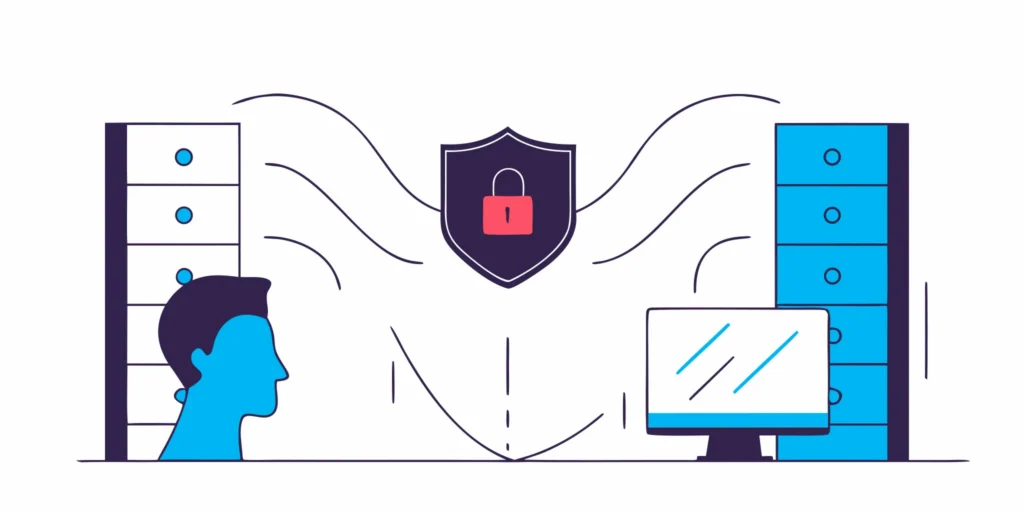
Global KYC compliance costs reached $38.8 billion in 2024, and enterprises carrying that weight face an escalating tension between airtight security and frictionless growth. Passive face verification resolves it: a user looks at a camera. The system confirms they are real and unique in under five seconds, and onboarding proceeds without a single extra click. No blinking, no document uploads, no drop-off.
Passive face verification confirms a person is real by matching a live image to a stored reference without requiring the user to blink. Turn their head, or perform any action. VerifEye by Realeyes runs this check in the background, blocking bots and synthetic identities while legitimate users never notice a thing. Trained on six million consented participants across 93 countries and backed by 17 granted patents. The technology costs $0.10 per call, a 90 percent reduction versus document-heavy alternatives that charge $1.00 or more per check. Unlike approaches that store biometric templates server-side, VerifEye processes everything on the user’s device and discards the source data immediately. Removing the single largest privacy risk in identity verification at scale.
Enterprises deploying face verification at scale need to understand how the technology works, where it fits in their stack, and what measurable outcomes it delivers. The sections that follow break down each dimension.
How Does Passive Face Verification Differ from Active Methods?
The distinction between passive and active face verification is not a technical footnote; it is the single largest determinant of onboarding completion rates. Active verification asks users to perform scripted actions: blink three times, smile, turn your head left and right. Each instruction adds friction, and cumulative friction converts willing users into drop-offs. This is why understanding the difference matters before choosing a verification partner.
Mars Inc, a Realeyes customer since 2016, experienced what happens when friction vanishes. The company deployed attention measurement across its global brand portfolio and documented $30 million in advertising cost savings within 18 months. Alongside an 18 percent incremental sales lift across 19 markets. While that case sits in the advertising domain, the same principle applies to identity verification: remove the burden on the user and conversion follows.
The Friction Cost of Active Liveness
Active liveness detection follows ISO 30107-1 standards, the same framework that governs presentation attack detection for high-security environments. These standards are rigorous, but the user experience they impose is punishing at scale. A typical active check runs ten to twenty seconds. On a mobile device in low light, with an impatient user, that interval feels far longer.
The cost compounds. Authentication friction drives abandonment rates above 50 percent for many financial and gaming platforms. Each abandoned sign-up represents wasted acquisition spend, a longer time-to-value, and a potential customer who now associates the brand with inconvenience. Active verification methods reduce fraud but create a secondary problem: the fraud of lost revenue from users who never finished onboarding.
Passive Verification Eliminates the User Burden
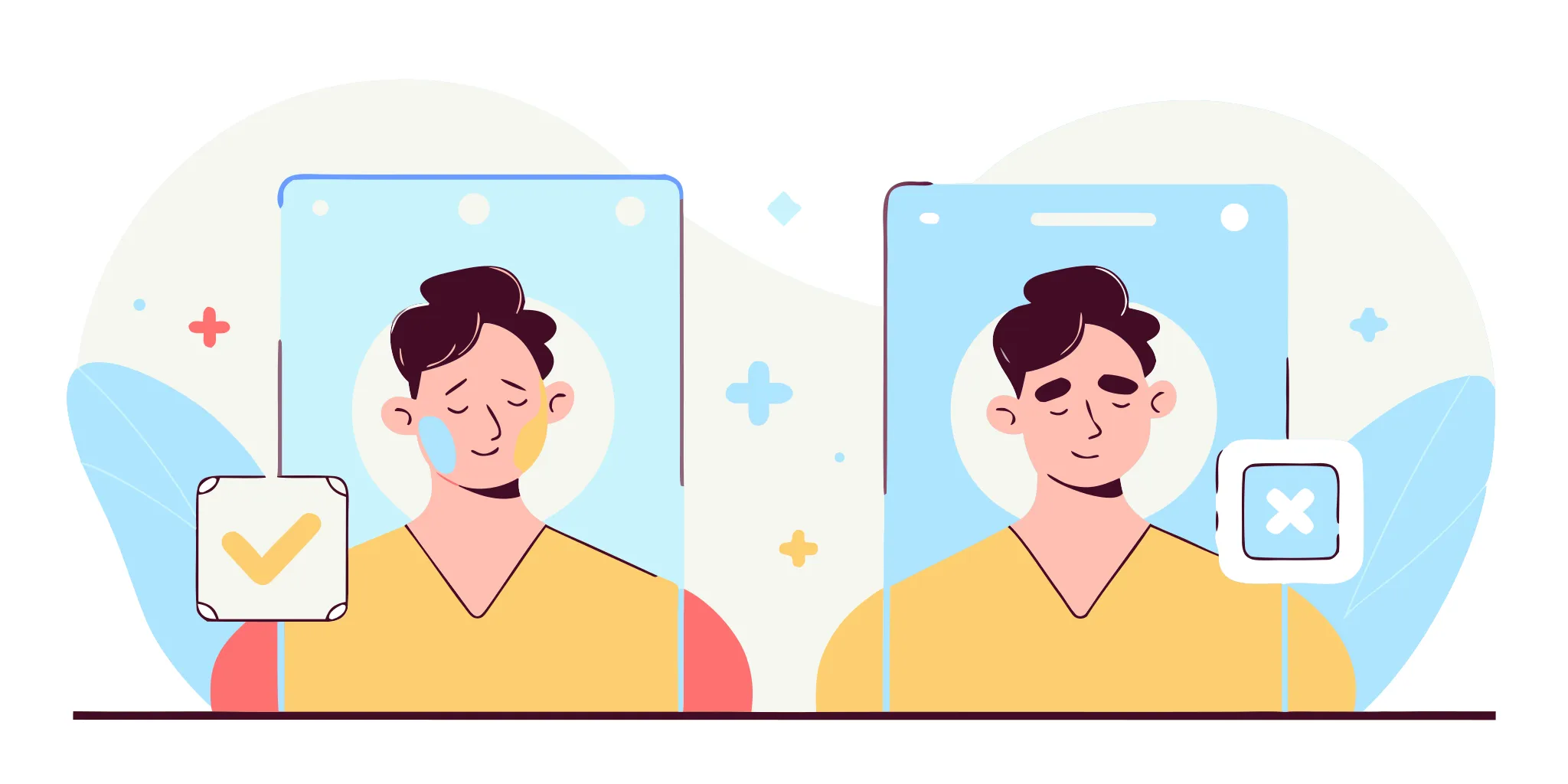
Passive verification inverts the equation. The user does nothing except look at the screen. The system captures a brief video stream, analyzes it for liveness markers such as skin texture. Infrared reflection, and three-dimensional facial structure, and returns a result in under five seconds. Passive liveness detection achieves equivalent or superior fraud resistance while reducing the user action requirement to zero.
| Dimension | Active Methods | Passive (VerifEye) |
|---|---|---|
| User Action Required | Blink, smile, head turns | Look at camera only |
| Time to Result | 10-20 seconds | Under 5 seconds |
| Spoof Resistance | High | Very High |
| Onboarding Drop-off | Significant | Near Zero |
| Cost per Verification | $1.00 or more | $0.10 |
What Enterprise Outcomes Does Passive Face Verification Drive?
Enterprise leaders evaluating new verification technology ask a pragmatic question: what will this deliver in measurable terms? Three categories of outcome define the ROI case for passive face verification. And each one translates directly to a line item that finance and security teams can evaluate before committing to a deployment.
Reducing Onboarding Abandonment
When Kantar Profiles, a global market research firm, needed to stop bots from contaminating its panel data without frustrating legitimate participants, it turned to VerifEye. The result: 96 percent fraud detection accuracy with a 0.67 percent false positive rate. Real participants sailed through; fraudulent accounts were blocked with surgical precision. Real user versus bot identification at this accuracy level means onboarding teams stop spending time on manual review and focus on legitimate user growth instead.
The business impact of this accuracy extends beyond operational efficiency. When false positive rates stay below 1 percent, legitimate users are almost never flagged. That means no support tickets from frustrated customers, no manual review queues, and no drop-off caused by false rejections. For a platform onboarding 500,000 users per quarter. Even a 2 percent false positive rate would incorrectly block 10,000 real people who then need to contact support or abandon the process entirely. VerifEye’s 0.67 percent false positive rate keeps that number near zero.
Slashing Verification Costs by an Order of Magnitude
Most identity verification vendors charge between $0.80 and $1.50 per successful check. For a platform processing one million new users per month, that translates to $800,000 to $1.5 million in monthly verification costs. VerifEye pricing at $0.10 per call brings the same monthly cost to $100,000, a $700,000-plus monthly saving that scales in direct proportion to user growth.
This cost advantage is not achieved by cutting corners. The platform processes data on the user’s own device, converting facial images into non-reversible numeric representations and discarding the source immediately. No images are stored, no documents are collected, and the infrastructure cost of managing sensitive biometric data disappears. Biometric verification without storage risk is both a privacy advantage and a cost advantage.
Building Trust Through Responsible AI
User trust in biometric systems has eroded as data breaches and surveillance concerns dominate headlines. VerifEye addressed this head-on by becoming the first vision AI system to pass Google’s and Meta’s responsible AI audits. The fairness of the underlying models is tested across skin tones, ages, lighting conditions, and geographic regions. Because a system that fails for ten percent of users is not scalable for global enterprises.
PwC audits the platform annually and has documented a flawless ten-year track record. Realeyes holds 17 granted patents with 18 pending, and the company’s commitment to responsible face verification is embedded in every layer of the product design, not retrofitted as a compliance checkbox.
How Does Passive Face Verification Stop Deepfakes and Spoofing?
The deepfake detection market is projected to grow from $1.14 billion in 2025 to $8.11 billion by 2030 at a 48 percent compound annual growth rate. Enterprises cannot afford to deploy verification that fails against the current generation of AI-generated attacks. This question of resilience against evolving threats is central to any enterprise-grade deployment.
Defense Against Presentation Attacks
Sophisticated fraud rings use multiple vectors: printed photographs, video replays on high-resolution screens, silicone masks, and real-time deepfake avatars that mimic facial movements. Each attack type exploits a different vulnerability in naive verification systems.
VerifEye counters these threats through infrared pixel-depth analysis that maps the three-dimensional structure of a face. A photograph or screen replay produces a flat depth map. A real human face produces a volumetric scan consistent with a solid object. The system also analyzes light-bounce patterns and micro-expressions that synthetic media cannot replicate. Enterprise deepfake detection at this granularity requires a neural network architecture trained on 2.5 billion AI labels. A dataset that gives the model an unusually broad understanding of what real human faces look like across every conceivable condition.

Liveness Detection Without User Cooperation
Since passive liveness detection does not require the user to perform a challenge-response action. It cannot be gamed by recording a video of a compliant subject and replaying it. The check is silently initiated by the SDK and completes before the user finishes entering their email address. Liveness detection for AI fraud in this passive mode means the attacker never knows precisely when the verification window opens or closes, making replay and pre-recorded video attacks far harder to execute.
This timing advantage matters in practice. Consider a fraud ring that has collected a high-resolution video of a target user from social media platforms. With active verification, they can play that video on a tablet and mimic the requested actions. With passive verification, the SDK probes for depth, texture, and infrared signatures that a flat screen cannot reproduce. The attack fails at the first frame. The combination of passive capture and multi-modal liveness analysis makes VerifEye resilient against the most common spoofing vectors. Including those used in account takeover and synthetic identity fraud today.
The platform’s training set spans 6 million consented participants across 93 countries, ensuring the model generalizes across diverse populations. Passive liveness detection software that performs equally well for a user in Tokyo and one in Sao Paulo is the difference between a global-ready solution and a product that works only in controlled demographics.
Integrating Passive Face Verification Into Your Enterprise Stack
The integration path for VerifEye is deliberately shallow. Two lines of JavaScript for web applications; SDK support for iOS, Android, Python, .NET, Unity, and C++. A single RESTful POST call to the verify endpoint returns a result in under five seconds. Enterprise teams appreciate this minimal integration surface because it reduces development time and eliminates the need for specialized biometrics engineering staff.
- Select your SDK. Choose from seven platform targets including mobile, desktop, and game engines.
- Add the snippet. Two lines of JavaScript for web deployments hook the camera and handle the verification loop.
- Call the API. A POST request to the verify endpoint with the captured signal returns pass or fail alongside a confidence score.
- Interpret the result. The response includes liveness confirmation, uniqueness validation, and optional demographic attributes such as age estimation.
- Choose deployment. Cloud SaaS, on-premise, or hybrid infrastructure depending on your data residency and compliance requirements.
The system follows NIST digital identity guidelines and supports the same standards used by enterprise security teams for IAM integration. Document-free human verification means your organization never collects, stores, or manages sensitive government IDs, a significant reduction in compliance surface area under GDPR, CCPA, and emerging AI governance frameworks.
Frequently Asked Questions
How does passive face verification protect user privacy?
Passive face verification converts biometric data into a non-reversible numeric code through on-device processing. The source image is never transmitted to a server and is deleted immediately after the check completes. Identity verification without stored images eliminates the single largest privacy risk in traditional biometric systems: the centralized database of face photos that, once breached, cannot be reissued like a password.
Can passive face verification stop AI-generated deepfakes?
Yes. The system analyzes depth, texture, infrared reflection, and micro-movements that AI-generated faces and video replays cannot reproduce. The model was trained on the largest fully GDPR-compliant dataset of real human faces, giving it a statistically grounded baseline of what authentic liveness looks like. Deepfake prevention in account verification requires this depth of training data to stay ahead of generative AI advances.
Is passive verification more secure than active liveness checks?
Passive and active methods target different attack surfaces, but passive verification eliminates the most common attack vector: a recorded video of a compliant user performing the requested actions. Because the user never performs a visible challenge, there is no action for an attacker to record and replay. The 17 granted patents covering Realeyes’ approach to presentation attack detection provide an additional layer of defensibility.
How much does enterprise face verification cost at scale?
VerifEye costs $0.10 per API call with volume discounts available for large-scale deployments and unlimited license models for strategic partnerships. This represents a 90 percent reduction compared to the $1.00 per-check average among identity verification specialists. Passive liveness check pricing at this level makes it economically viable to verify every user on every interaction, not just high-risk transactions.
How quickly can an enterprise team integrate passive face verification?
Most development teams complete integration within an hour. The web deployment requires two lines of JavaScript. SDKs are pre-built for major platforms. The API returns results synchronously, so no polling or webhook infrastructure is needed. The VerifEye platform supports cloud, on-premise, and hybrid deployment models to match enterprise infrastructure preferences.
Verify Real Humans. Without the Friction.
VerifEye confirms users are real and unique in seconds. No documents, no stored data, no drop-off.
Request a demo to see how passive face verification can transform your enterprise onboarding flow, reduce costs by 90 percent, and eliminate verification friction for every new user.