

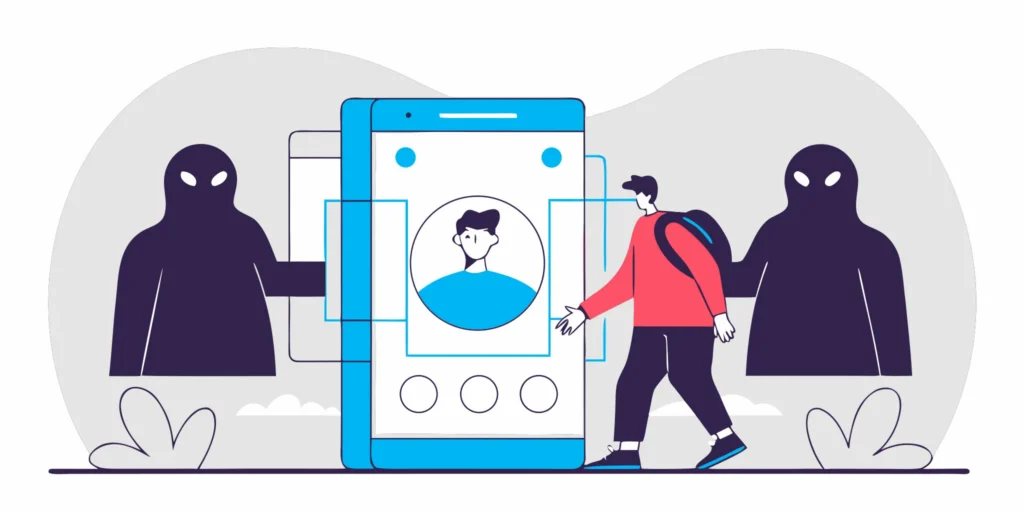
Schedule a demo today if you run a gaming platform or online marketplace and duplicate signups are quietly draining your marketing budget. A single fraudster can spin up hundreds of fake accounts to pillage bonuses, rig reviews, and crash your user metrics. The old solution (demanding a government ID) stops the bad actors but also drives away the real customers you actually want. The better path is passive face verification, which confirms each user is a unique human being without scanning a single document. Here is the problem product and security teams face: you need ways to prevent multiple accounts that actually work at scale, but the moment you add friction, your conversion rate drops. Most teams reach for the tools they know (IP blocking, device fingerprinting, email verification) only to discover that modern fraud rings have an answer for all of them. The systems designed to keep bad actors out have turned into a game of cat and mouse where the mice keep inventing better disguises. Passive face verification changes the game entirely. Instead of asking “what device is this person using?” it asks “is this person real, and have we seen them before?” VerifEye handles both questions in under a second without storing a single image. Product teams get clean user metrics. Security teams get a 10x cost advantage over ID-based checks. And real users get a signup flow that does not feel like a background check.
What Is the Real Cost of Duplicate Accounts?
Duplicate accounts are not a minor technical annoyance. They are a direct drain on revenue, trust, and data quality. When one person controls dozens of profiles, they exploit every system that assumes each account represents a unique human being. The damage spreads across three dimensions.
Distorted metrics and broken analytics
If your platform thinks it has a million users but a third of them are duplicate accounts controlled by a few hundred bad actors, every business decision built on that data is suspect. Customer acquisition cost looks artificially low. Engagement rates get inflated by bot activity. Retention numbers lie to you. Product teams rely on clean user data to prioritize features and allocate spend, and duplicate accounts inject noise into every signal. The only way to prevent multiple accounts from corrupting your analytics is to verify that each signup represents a genuinely new person. This is why the National Institute of Standards and Technology spells it out clearly: platforms must maintain a unique subscriber account for each individual user. NIST wrote the rule because the data proves that duplicate accounts cause measurable harm, and pretending otherwise only compounds the damage over time.
Bonus abuse and direct financial losses
The most expensive form of multi-accounting is bonus abuse. Sign-up incentives, welcome credits, and first-purchase discounts are designed to acquire genuine customers. Fraud rings treat them as an ATM. They spin up account rings to claim the same bonus hundreds or thousands of times, turning your best growth lever into a direct loss. Some networks have identified more than 300,000 fake signups during their early growth phases. Industry detection systems have blocked over half a million fraudulent registrations in a single year. The math is brutal: if each fake account claims a $10 signup bonus, that is millions of dollars funneled straight to fraud rings. Active ways to prevent multiple accounts at the registration gate are the only defense that scales.
Trust erosion in gaming and marketplace economies
Online gaming communities depend on fair competition and balanced economies. When players use multiple accounts to farm rare items, manipulate leaderboards, or evade bans, the experience degrades for everyone. Legitimate players quit, and the platform is left with an ecosystem built on sand. Marketplaces face the same dynamic with fake reviews. A seller with ten positive reviews might be legitimate. A seller with ten positive reviews from ten accounts controlled by the same person is running a scam. Buyers eventually catch on and take their business elsewhere. The cost of failing to detect duplicate accounts compounds as trust erodes, and restoring trust is far harder than preserving it.
Why Requiring ID Documents Drives Users Away
The instinct to ask for a government ID makes sense on paper. An ID document proves that someone is a real person with a legal identity. In practice, the approach creates so much friction that it costs more in lost revenue than it saves in prevented fraud.
Friction kills conversion
Asking a new user to find their passport or drivers license, take a clear photo, upload it, and wait for verification adds minutes to a signup flow that should take seconds. Every additional step costs you a percentage of would-be users. For global audiences, the drop-off is even steeper because not everyone carries the type of ID your system accepts. When users encounter an ID wall, many simply leave and find a platform that does not demand their private documents. The irony is that the most valuable users (the ones who value their privacy and have something to lose) are the most likely to abandon the flow. The fraudsters, who have a financial incentive to complete the process, are the most likely to persist. The system ends up filtering out your best customers while the bad actors find workarounds.
The cost per check adds up fast
Traditional identity verification services charge between $0.80 and $1.00 per check. For a platform processing a million signups per year, that is nearly a million dollars in verification costs alone. VerifEye delivers the same assurance at up to 10x lower cost by running the verification locally on the users device and only sending an anonymous mathematical representation to the server. Privacy is the other hidden cost. Storing copies of government IDs turns your platform into a high-value target for data thieves. A breach of ID documents triggers regulatory penalties, lawsuits, and reputational damage that can dwarf the original fraud losses. Passive face verification eliminates this risk entirely by design. The system never stores or transmits a raw image, which means there is nothing for an attacker to steal.
Why Device Fingerprinting and IP Checks Fall Short
Most platforms start their anti-fraud strategy with basic device and network signals. These tools worked well a decade ago, but the fraud industry has evolved faster than the defenses designed to stop it. Here is what product and security teams are up against.
Anti-detect browsers render fingerprinting obsolete
Tools like Multilogin and GoLogin let fraudsters create a complete fake digital identity for every account they open. These applications spoof browser fingerprints (screen resolution, installed fonts, timezone, language settings) to make each session look like it comes from a unique device. A single person running a hundred accounts on one laptop looks like a hundred different users to your fingerprinting system. These tools also automate the entire account creation pipeline. They cycle through proxy lists, generate unique email addresses, fill in profile details, and complete CAPTCHAs faster than a human could. By the time your security team identifies a pattern, the fraud ring has already moved to a new set of fingerprints.
Residential proxies bypass IP-based blocks
IP blocking used to be a reliable way to stop multi-accounting because fraudsters needed data center IPs that were easy to identify. That has changed. Residential proxy networks route traffic through real home internet connections belonging to real people. Your system sees an IP address from a legitimate ISP in a normal residential neighborhood and trusts it. Fraudsters rotate through thousands of these residential IPs, making it impossible to block by location or IP range. Combined with temporary email addresses that self-destruct after a few minutes, the marginal cost of creating a new fraudulent account is effectively zero. Device fingerprints change, IPs change, email addresses change, but the person behind them stays the same. That is the signal you actually need to check.
The biometric answer
The only reliable way to detect a fraudster who keeps changing their digital disguise is to verify the person instead of the device. Passive face verification solves this by checking whether the face behind the camera matches any existing account, regardless of the IP address, browser settings, or email domain the user presents. A fraud ring can rotate through a thousand proxies, but they cannot rotate through a thousand unique faces.
How Does Passive Face Verification Stop Multiple Accounts?
The technical workflow is simple enough to describe in a few sentences but robust enough to handle millions of requests per day. Here is how it works.
The signup flow in four steps
- The user takes a brief selfie during signup, captured through their phone or laptop camera in a few seconds.
- Passive liveness detection confirms the user is a real, live person in that moment, not a photo, video replay, or deepfake.
- The system converts the face into an anonymous mathematical representation and checks it against every existing user in the database. This is a 1:N match (one face against millions).
- If no match is found, the account is created and the raw selfie is discarded immediately. Only the anonymous face code is retained for future checks.
The entire process takes about a second. Users experience it as a quick glance at their camera, not a document scan or a waiting period. For product teams, this means zero-friction onboarding. For security teams, it means a definitive answer about whether this user has been seen before.
Key advantages over legacy systems
- Cost: Up to 10x cheaper than document-based KYC checks because processing happens on the device
- Privacy: No raw images are ever stored. The system only retains a mathematical face code, which reduces compliance burden under GDPR and similar regulations
- Speed: Verification completes in under a second, keeping signup conversion rates at their natural level
- Global reach: Works for any user with a camera, regardless of whether they have a government ID
- Scale: Built to handle over a million checks per day without degrading performance
These advantages add up to a system that product and security teams can agree on. Product teams protect their conversion funnel. Security teams close the multi-accounting loophole. And users keep their privacy intact.
What Product and Security Teams Should Know About Face Uniqueness at Scale
Deploying face-based uniqueness checks across millions of users requires attention to three operational dimensions: matching accuracy, traffic handling, and privacy architecture.
1:N matching across large databases
The core technical challenge is 1:N matching (comparing a new face against every existing entry in the database and returning a result in real time). Gaming platforms and marketplaces with millions of registered users need this comparison to complete in milliseconds. Anything slower creates a bottleneck at the signup gate. VerifEye handles this by running the comparison on-device where practical, and by using an efficient vector search for the database lookups that must happen server-side. The result is a match that completes as fast as the device can capture the image, with no perceptible delay for the user.
Traffic spikes and real-time performance
Gaming platforms see massive spikes around new game launches, tournaments, and promotional events. A system that handles a million checks per day needs to handle five million on launch day without slowing down. The on-device architecture helps here because the heavy computation is distributed across user devices rather than concentrated on your servers. Your infrastructure cost scales with database lookups, not with image processing.
Privacy-by-design architecture
VerifEye was built from the ground up to avoid creating a central repository of human faces. The system captures a selfie, extracts a mathematical representation, and discards the raw image before the representation is ever transmitted. This means there is no database of photos to breach, no compliance headache with data retention laws, and no user trust issue around what happens to their image after signup. Independent audits by firms like Google and Meta have validated the fairness and accuracy of the underlying AI. The system is fully opt-in (every user must consent before the camera activates), which aligns with the core principle of building a more human internet rather than a more surveilled one.
Frequently Asked Questions
How can I prevent users from creating multiple accounts?
Do I need ID documents to stop multiple account creation?
How do platforms block account rings?
What is the impact of multi-accounting on digital platforms?
Verify Real Humans. Without the Friction.
VerifEye confirms users are real and unique in seconds. No documents, no stored data, no drop-off.
Request a demo to see how passive face verification can shut down duplicate accounts across your platform.