

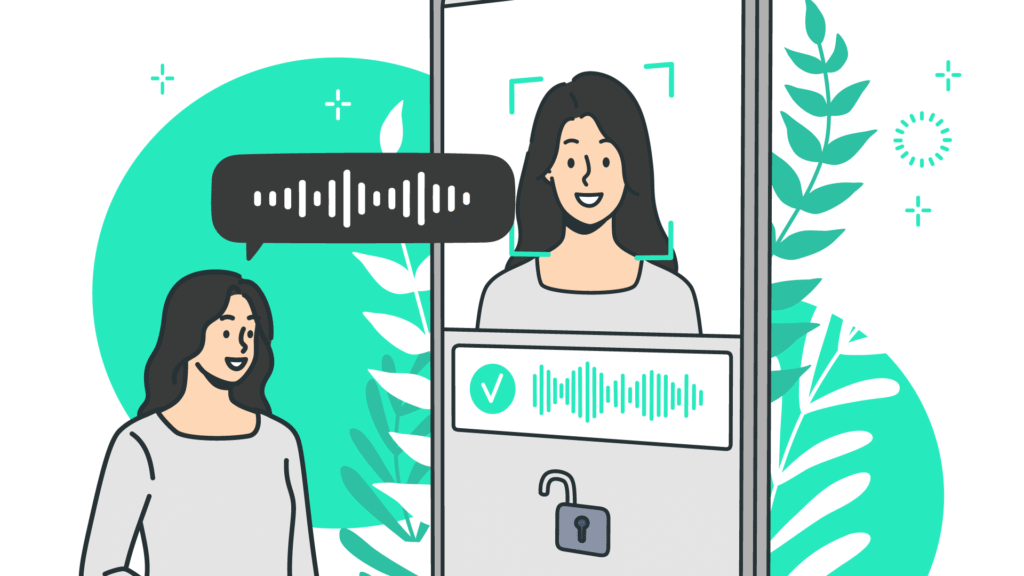
A familiar voice used to be a reliable signal of identity. Today, it’s also an asset that can be copied, synthesized, and deployed the moment a payment, account change, or urgent request is on the line. As a result, voice cloning fraud shifts the real question for enterprise teams: not whether a voice sounds familiar, but whether a real person is actually there.
Voice cloning fraud uses AI-generated speech to impersonate trusted people in vishing, social-engineering, and account-takeover attempts. Audio alone cannot reliably prove who is speaking or whether that person is present. As a result, liveness-based human verification adds a separate signal. It confirms that a real person is interacting with the system right now. The synthetic voice is rarely the whole attack. It’s usually one part of a workflow designed to make an irreversible decision feel routine. The sections below explain how that workflow operates and where VerifEye’s liveness checks close the gap.
How Voice Cloning Fraud Works
Voice cloning fraud starts with a speech sample, continues with synthetic audio that imitates the speaker, and ends with a believable pretext. The attacker doesn’t need a perfect replica — the voice only needs to sound credible long enough to prompt a transfer, credential disclosure, account change, or control bypass.
Modern speech systems can model recognizable traits such as cadence, pronunciation, pitch, and vocal texture. The source may be a public interview, a social-media video, a podcast, a voicemail greeting, or a compromised business channel. Even a short, clean recording can supply enough material to generate words the target never actually said.
The FTC’s guidance on harmful voice cloning describes both family-emergency impersonation and executive requests for fraudulent wire transfers. In other words, the technology strengthens the impersonation layer, but the fraud still depends on a social situation that pressures someone to act.
- Capture a usable sample. The attacker collects enough speech to model recognizable vocal features.
- Generate synthetic speech. A cloning system turns those features into new words, often with convincing pacing and tone.
- Choose a pretext. The caller may pose as an executive, supplier, customer, official, or support agent, using existing information to make the scenario feel specific.
- Trigger a decision. The audio appears in a call, voicemail, or voice message requesting money, access, credentials, or a process exception.
The final step is where the real weakness sits. The clone doesn’t need to pass a lab test; it only needs to survive a rushed conversation. Consequently, an employee who would question an unexpected email may respond very differently when a familiar voice creates urgency, authority, or personal obligation.
Why Audio Alone Cannot Prove a Person is Present
Audio analysis can estimate whether speech resembles a known voice, but resemblance isn’t presence. A recording can replay a genuine voice while the speaker is nowhere near the call, and synthetic audio can imitate the relevant characteristics without a real voice behind it at all — either way, the system evaluates a sound rather than the person supposedly making it. So enterprises should treat audio as one input in a layered risk decision, not the sole basis for identity assurance.
A voice-print system can compare a sample to a stored pattern or flag signs of manipulation, which adds useful context. Still, it doesn’t answer the question that matters most in a high-risk interaction: is the person associated with the voice actually present and participating now?
Similarity is Not Liveness
Research from the National Library of Medicine looked at human detection of AI-generated voice clones. In fact, it backs up a practical conclusion for security teams: people are not reliable detectors of generated speech. Short, noisy, compressed, or emotionally charged calls make careful listening even harder. Instead, the burden shouldn’t fall on a listener catching a strange vowel or an odd pause.
That said, audio still has a place in defense-in-depth: anomaly scoring, call analysis, and post-incident investigation. Still, it’s simply not suitable as the only gate for payment approval, account recovery, or a privileged change. A control that only proves a sound resembles a person still leaves open the possibility that the person is absent. In short, that’s exactly the gap VerifEye’s liveness check is built to close. It confirms a real, unique person is present at the moment the decision is made, not after the fact.
“A control that only proves a sound resembles a person still leaves open the possibility that the person is absent.”
Realeyes’ deepfake detection API guide applies the same principle across synthetic media generally: match authenticity signals to what the system actually needs to prove.
Where Voice Cloning Fraud Creates Enterprise Risk
Voice cloning fraud creates risk wherever a familiar voice can sway a consequential decision — most often executive payment requests, supplier changes, account recovery, contact-center authentication, and messages designed to talk employees or customers into weakening an existing control.
The attack surface reaches well beyond finance. Any workflow that treats a voice as a shortcut to trust is a potential target, and attackers routinely combine public information, breached data, and ordinary social engineering to make a request feel specific rather than generic.
Executive and Supplier Impersonation
An attacker might imitate a senior leader to request an urgent transfer. Or they might pose as a supplier while changing payment instructions. The voice supplies authority; the deadline supplies pressure. Together they push a recipient to skip a second channel or treat an unusual instruction as routine. Notably, this is exactly where a step-up liveness check earns its place. Routing high-value payment approvals through a live, on-device presence check, not a voice alone, removes that shortcut.
Account Recovery and Contact Centers
Certainly, voice-based support feels personal and efficient. But that’s exactly what makes it a liability. A caller with a convincing voice can move an account through recovery or change contact details. A voice check can help, but it shouldn’t replace controls that verify the person and the transaction context. In practice, VerifEye’s on-device liveness check gives contact centers a fast alternative. It replaces voice matching or knowledge-based questions an attacker can simply research. Before a sensitive change goes through, the caller completes a brief camera-based presence check. It confirms a real, unique person, not just a familiar voice, is on the line.
Importantly, deepfake prevention isn’t purely a technical problem across any of these exposure points. Policy, approval paths, and channel separation matter just as much, as this breakdown shows:
| Exposure point | What the attacker wants | More durable control |
|---|---|---|
| Executive payment request | A wire transfer or urgent purchase | Independent approval and verified callback |
| Supplier or customer call | Payment-detail or account changes | Out-of-band confirmation and change controls |
| Account recovery | Credentials, reset access, or contact changes | Layered identity and liveness checks |
| Contact-center interaction | Information or a workflow bypass | Risk-based step-up verification |
Similarly, Realeyes’ fake-account detection guide covers the same trust question: whether the account, the interaction, and the person together meet the level of trust the action requires.
Can Audio Detection Stop Voice Cloning Fraud?
Audio detection can flag suspicious characteristics and support investigation, but on its own it cannot stop voice cloning fraud. An attacker can switch to a replay, generate a new synthetic sample, or move to a different channel entirely. As a result, detection works best alongside procedural controls, transaction monitoring, and verification of real human presence.
Detection tools can inspect spectral patterns, artifacts, or timing inconsistencies to help prioritize a call for review and support incident response, but the limitation isn’t that audio analysis has no value. It’s that it observes the signal rather than establishing the full identity event, and attackers can change the conditions around that signal just as easily: a replayed recording instead of generated speech, a voice note instead of a call, added background noise, a shorter exchange. A model that performs well against one generation method may not answer whether a different interaction contains a real, unique person.
A layered design should therefore separate three questions:
- Does the audio show signs of manipulation? Use audio analysis and investigation signals.
- Is the request consistent with policy and transaction context? Use approval workflows, anomaly detection, and independent confirmation.
- Is a real person present and unique? Use a liveness-based human-verification step where the risk warrants it.
This separation avoids a common category error: a detector can say content appears suspicious, but it can’t say the person behind the account is real, unique, and present. Those are different claims, and they require different evidence.
What Liveness Verification Adds
Liveness verification adds evidence about the interaction itself. Instead of asking whether audio resembles a known speaker, liveness asks something different. Is a real person present, and can they complete the verification flow? Combined with uniqueness and risk context, that signal closes exactly the gap voice similarity leaves open.
In short, liveness shifts the object of verification from a voice to a person. In a VerifEye flow, the user completes a short, camera-based check on their own device. Then, within seconds, the system determines whether the interaction comes from a real, unique person. Consequently, it rules out a replay, a synthetic artifact, or an automated account. Crucially, this happens on-device. VerifEye doesn’t require government ID documents, and it doesn’t store images or raw biometric data during the service. As a result, the check can sit inside a payment approval, an account-recovery flow, or a contact-center escalation. It doesn’t add a document-heavy step.
For enterprise teams, though, the value isn’t a claim that one check solves every fraud problem. Instead, it’s a signal that synthetic audio can’t provide. It’s proof a specific, real person is present at the exact moment a high-risk decision is made. The Realeyes overview of liveness detection and user authentication explains this signal in more depth.
Liveness should still be deployed thoughtfully. Use clear consent and explain the purpose of the check. Apply risk-based step-up rules, and retain only the data the approved process requires. Privacy-preserving verification is part of whether the control will actually be accepted and used consistently.
How to Reduce Voice Cloning Fraud Risk
Reducing voice cloning fraud risk takes a combination of policy, channel separation, detection, and human-presence verification. First, make urgent requests harder to complete through a single conversation. Then add liveness-based checks wherever the organization needs stronger evidence that a real, unique person is interacting.
Make Verification Procedural, Not Personal
Don’t ask employees to win an argument with a convincing voice — give them a process that works even when the voice sounds exactly right. Payment and account-change policies should require independent confirmation through a known channel, with exceptions documented and reviewable rather than granted because a caller sounds familiar.
Reduce Avoidable Audio Exposure
Public content can’t always be removed, and an organization shouldn’t pretend otherwise. It can, however, review what executives, support teams, and public-facing employees publish, limit unnecessary recordings, and protect internal audio from becoming an easy source of high-quality samples. The goal isn’t silence; it’s reducing avoidable exposure.
Match Controls to Consequence
Notably, a low-risk informational call doesn’t need the same flow as account recovery or a high-value payment. First, map actions by consequence. Then apply step-up verification wherever an impersonation decision could cause material harm, using the same three-part framework introduced earlier:
- Manipulation signs: apply audio analysis and investigation tooling to flag suspicious calls for review.
- Policy and context: require independent confirmation on workflows that touch money, access, or recovery channels — wherever voice is currently treated as an implicit authenticator.
- Human presence: add a VerifEye liveness check at the highest-risk steps, then measure friction and prevented events to refine the policy over time.
This keeps the response proportionate rather than forcing every interaction through the heaviest possible identity process. Ultimately, the objective isn’t to make a voice call impossible; it’s to ensure a familiar sound can never independently authorize a consequential action. See Realeyes’ deepfake prevention guide and solutions overview for implementation detail.
Frequently Asked Questions
How do AI voice cloning scams work?
An attacker obtains a short recording, uses AI to generate new speech, and places the synthetic audio inside a believable pretext — usually a request involving money, credentials, or account access. The voice creates familiarity, while urgency discourages independent verification.
Can AI voice cloning be used to impersonate a boss?
Yes. Attackers combine a cloned voice with public information about an executive, employee, or current project to make the pretext credible. The best defense is requiring independent confirmation for payment, access, and account-change requests, not asking employees to spot an imperfect vocal detail.
Can people reliably detect a cloned voice by listening?
No — performance is inconsistent, and short, compressed, or emotionally charged calls make careful listening even harder. Audio can support an investigation, but it shouldn’t be the only control used to establish identity or authorize a high-consequence action.
What is the difference between voice similarity and liveness?
Voice similarity asks whether audio resembles a known speaker; liveness asks whether a real person is present and interacting with the system right now. A replay can contain a genuine voice without the speaker present, and synthetic audio can imitate vocal characteristics without one, so the two signals address different risks.
What should an organization do after a suspicious voice call?
Pause the requested action, preserve call or message details, and confirm the request through an independent channel. Notify the security or fraud team, check whether credentials were exposed, and look for related attempts against others. A convincing voice is never evidence that a request was legitimate.