

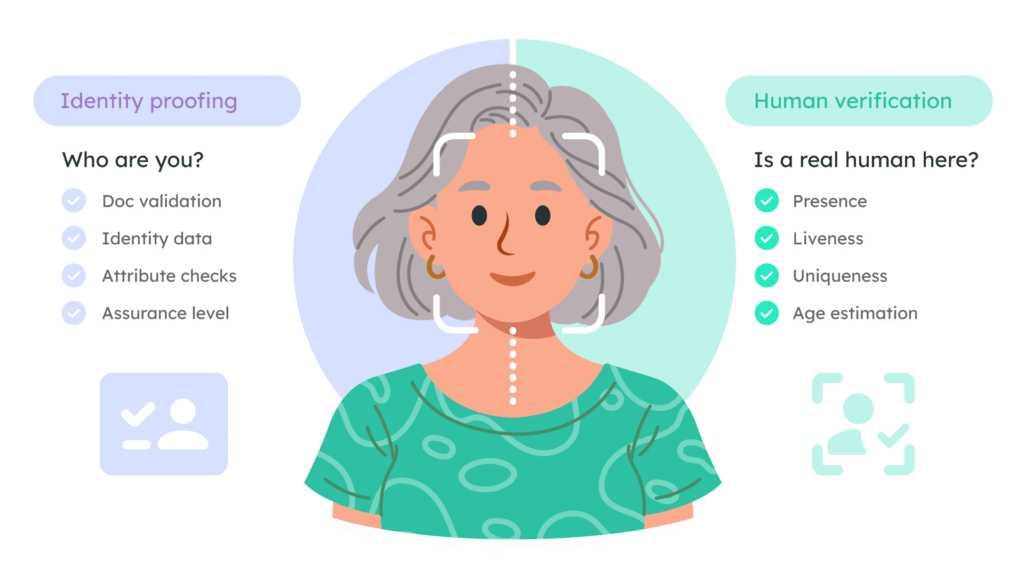
Identity proofing establishes who someone is. Identity verification confirms that the person interacting right now meets the condition the moment requires. Treat the two as the same thing and you get one of two problems: a slow, document-heavy sign-up, or a gap in trust that opens up later, usually at account recovery, a high-value transaction, or a returning session nobody thought to check.
A terminology note first. NIST uses “verification” as a step inside its identity-proofing process (NIST SP 800-63A-4, published July 2025, supersedes SP 800-63A). Commercially, the term is used more broadly: any check that confirms a person’s identity, presence or eligibility at a specific moment, separate from the original proofing event. This guide uses “identity verification” in that practical, enterprise sense, because that’s the language product, security and compliance teams actually use.
Key takeaways
- Identity proofing establishes a real-world identity at enrollment. Identity verification confirms a specific claim later, at login, recovery or a risky action.
- A third layer, human verification, answers a question proofing and verification don’t: is a real, live, potentially unique human behind this interaction right now?
- NIST’s “verification” is one component of proofing. The commercial usage in this guide is broader and event-based. Both are correct in their own context.
- Proofing shouldn’t be repeated by default. It’s an enrollment decision, not a ritual to run at every login.
- The right control depends on the actual question: identity, evidence, ownership, presence, uniqueness or ongoing assurance.
- VerifEye complements identity proofing. It isn’t a replacement for document-based KYC where legal identity is required.
| Trust question | Typical control |
|---|---|
| Does this identity exist or correspond to a real person? | Identity proofing |
| Is the evidence genuine and valid? | Document/evidence validation |
| Does the evidence belong to this person? | Face/document verification |
| Is a real human present now? | Human presence + liveness |
| Is this human unique on the platform? | Uniqueness |
| Is the same authorised person returning? | Reverification |
| Does the person meet an age threshold? | Age assurance / estimation |
Identity Proofing vs Identity Verification at a Glance
Identity proofing and identity verification serve different control objectives, and the table below sets them side by side before we go into either one in detail.
| Dimension | Identity proofing | Identity verification |
|---|---|---|
| Primary question | Does the claimed identity correspond to a real-world individual? | Is the person interacting now authorised, genuine or otherwise eligible? |
| Typical point in the lifecycle | Enrollment, account creation or regulated onboarding. | Login, recovery, transactions, step-up events or ongoing sessions. |
| Core activities | Identity resolution, evidence validation and attribute validation. | Comparison or signal checks against an account, credential, policy or risk condition. |
| Possible evidence | Documents, authoritative data, biometrics or other approved evidence. | Authentication factors, liveness, behavioural signals or other current-session evidence. |
| Operational outcome | Creates an identity relationship at a chosen assurance level. | Allows, challenges, limits or denies a specific action. |
What is Identity Proofing?
Identity proofing establishes that a claimed digital identity corresponds to a real-world person, at a defined assurance level. NIST describes this in three parts: identity resolution (which real-world person does this account represent), evidence validation (is the evidence genuine and connected to the applicant), and attribute validation (do the claimed attributes hold up against an appropriate source). The result isn’t a one-time check. It’s a record: an identity relationship the organisation can rely on for every later decision.
Evidence varies by risk. A government document, an authoritative record, knowledge-based evidence, biometrics, or some combination. Lower-risk services can use a lighter process. Access to financial assets, sensitive records or regulated services usually justifies more.
The question worth asking isn’t how intrusive a check can be made. It’s how much it would cost the business to get this particular decision wrong.
What is Identity Verification?
Identity verification is a check against an identity relationship, or against a defined requirement, that already exists. Is this returning user the authorised account holder? Is a real person present, not a spoof? Does this person meet an age or uniqueness condition? Verification runs at login, recovery, a transaction or another high-risk moment, and it doesn’t need to rerun the entire proofing process to do its job.
For a related discussion of how these signals differ in practice, see this guide to document and human verification.
Identity Proofing vs Authentication vs Human Verification
Five terms get used almost interchangeably in vendor material, and that’s a real source of confusion when teams design a control stack. Each one answers a different question:
- Identification: who do you claim to be?
- Identity proofing: can we establish that claimed identity?
- Authentication: can you demonstrate control of the account or credential?
- Identity verification: can we confirm the relevant identity/evidence relationship, right now?
- Human verification: is a real, live human actually participating?
Why Proving Identity Isn’t Enough
Proofing establishes the relationship, once
Proofing creates the baseline for every decision that comes after it. An enterprise needs to know whether the applicant is a specific individual, whether the evidence belongs to that individual, and whether the key attributes are accurate. Together, identity resolution, evidence validation and attribute validation turn an unestablished account into one with a defined identity context. None of that needs repeating at every login. It’s an enrollment decision, not a ritual.
“Identity proofing establishes who someone is. Identity verification confirms a specific claim. Human verification confirms someone real is here, right now.”
Verification carries the weight afterward
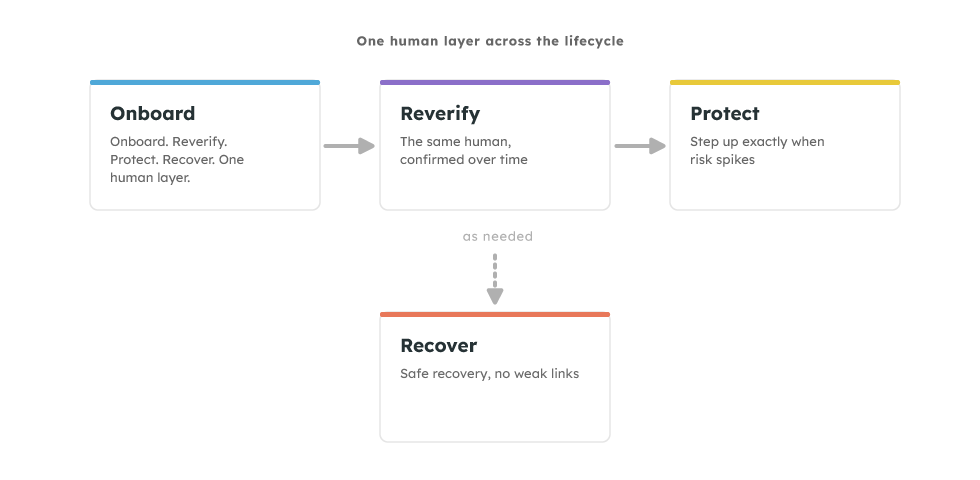
- Routine login: a proportionate, often passive check that confirms human presence and looks for signals of an automated or spoofed session.
- Account recovery: a change-of-control event that deserves more scrutiny than a routine login, since it’s an attractive target for impersonation and social engineering.
- High-risk actions: a step-up control at the exact moment risk increases, not friction spread evenly across the whole journey.
Where Human Verification Fits
Human verification asks whether a real person is present now, whether that person appears unique within the service, or whether the interaction meets a defined condition. It can sit alongside existing credentials, risk signals and proofing records without repeating the entire proofing workflow at every meaningful event.
VerifEye is built for this narrower, complementary role. It validates human presence and uniqueness, with liveness detection designed to identify spoofing attempts involving photos, videos and deepfakes. Its uniqueness capability can help identify duplicate account creation through privacy-preserving facial signatures, and it supports continuous verification so the check can extend beyond a single login where the risk profile changes. Selected age-range estimation can support age-related workflows where that signal is appropriate.
Do You Need Identity Proofing, Human Verification, or Both?
Most enterprises need more than one answer below, not because they’re being cautious, but because onboarding, login, recovery and high-risk actions are different risk events that call for different controls.
- Need to establish legal or real-world identity? → Identity proofing, document and evidence verification.
- Need to confirm the presenter matches the evidence? → Identity verification, biometric matching.
- Need to know a real person is present now? → Human presence and liveness.
- Need to stop one person creating multiple accounts? → Uniqueness.
- Need confidence again later? → Reverification, risk-based continuous checks.
How VerifEye Complements Identity Proofing
Identity proofing and VerifEye answer different questions, and that’s the point. A user can complete document-based proofing during onboarding, then return months later from a new device, attempt account recovery, or initiate a sensitive action. At those moments, VerifEye can confirm that the interaction comes from a live person rather than a scripted workflow, replayed media or a synthetic identity operation. It doesn’t establish every attribute in a government-issued document, and it isn’t meant to.
“VerifEye helps enterprises determine whether a real, live and unique human is present during onboarding, login, recovery, transactions and other high-risk interactions.”
VerifEye is available through REST APIs and SDKs for JavaScript, Android, iOS, Python, .NET, Unity and C++. Processing does not record or retain images; handling is on-device or in memory, with only essential metadata retained where needed. Teams evaluating this model can read more about verification without stored images.
VerifEye Use Cases
- Banking: document-based proofing at account opening, then human verification during recovery or high-risk actions.
- Marketplace: prevent account farms and repeated participation without necessarily requiring legal identity for every interaction.
- Gaming: confirm real-human participation, reduce automated abuse and support age-related controls.
- Web3: support personhood or uniqueness while preserving the possibility of pseudonymous interaction.
- Research and panels: reduce bots and duplicate participation where legal identity isn’t the objective.
What VerifEye Does and Doesn’t Do
Sometimes document verification solves a different problem than the one an organisation is actually trying to solve, whether that’s stopping duplicate accounts, bots, marketplace abuse or account-recovery fraud. The table below sets out where VerifEye’s role starts and stops.
Privacy and Data Minimisation
Strong assurance doesn’t require collecting every possible data point. It requires collecting the right evidence for a defined purpose, handling it carefully, and being able to explain the decision later.
Purpose and consent
State exactly what the check is meant to establish, document the legal and operational basis, and make sure consent is explicit, informed and tied to the relevant policy rather than a generic checkbox.
Necessary data
Map every input, derived signal and output, then challenge each one: does it materially improve the decision, or is it collected because it might be useful someday? VerifEye does not record or retain images; processing happens on-device or in memory, with only essential metadata retained where needed.
Processing location and retention
Document the processing location, subprocessors, transfer mechanisms and access boundaries, covering logs, support exports, backups and development data. Retention should have a defined purpose and a deletion trigger, not an indefinite “just in case”.
Fallback and auditability
Every fallback path should preserve an appropriate assurance level without pushing a user toward a more invasive alternative. And the decision itself should be auditable through consent records, policy version, event time, result and reason codes, without creating a second repository of sensitive identity data.
“The useful question isn’t whether document verification is better. It’s whether it’s solving the problem you actually have.”
Frequently Asked Questions
What does identity proofing establish?
Identity proofing establishes that an applicant is a real-world person associated with a claimed identity, at a defined level of assurance, through identity resolution, evidence validation and attribute validation. NIST describes these proofing steps in its digital identity guidance.
Can identity verification happen without repeating full proofing?
Yes. Once an account and its assurance requirements are established, later checks can focus on whether the returning person is the authorised user, or whether a required condition is met, typically at login, recovery or before a high-risk action.
Does VerifEye replace KYC?
No. VerifEye is not a replacement for document-based identity proofing when an organisation must establish legal identity or meet a specific KYC requirement. It complements that layer by confirming human presence, liveness and uniqueness at the moments proofing doesn’t cover.
Where does human verification fit?
Human verification addresses a different question from document-based proofing: is a live person present, and does the interaction show signs of spoofing? It can support onboarding, account integrity, recovery or step-up controls while limiting unnecessary data collection, and it should complement, not replace, the proofing evidence a given risk and regulatory context requires.