

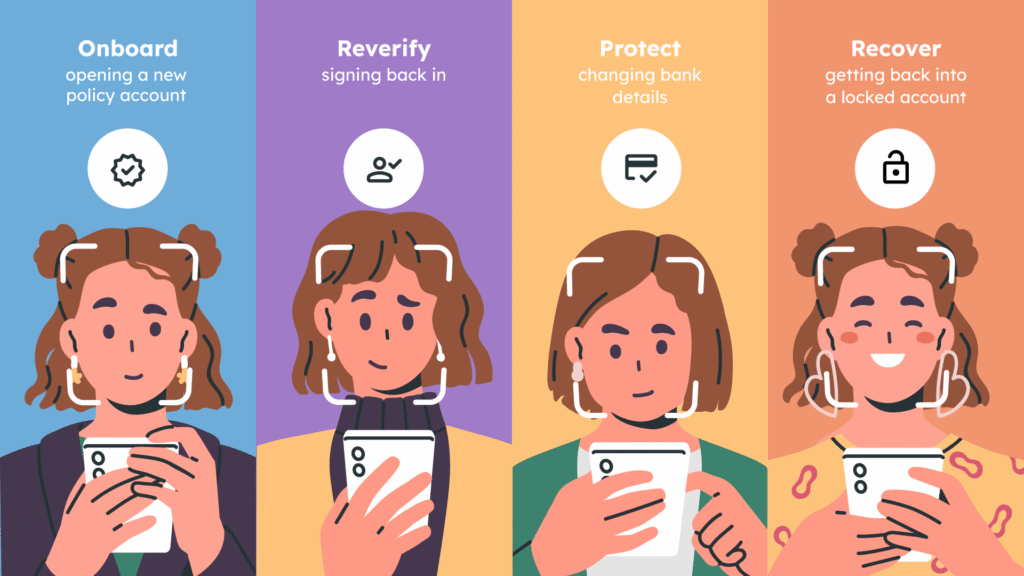
Insurance fraud rarely starts with a dramatic break-in. It starts when a person, an account, or a claim looks just credible enough to pass through a digital workflow.
Insurers cut claims fraud by pairing identity checks with liveness and uniqueness checks at sensitive moments: account creation, claim submission, and payout changes. These checks confirm a claimant is a real person, not a spoofed or synthetic identity. Risk-based orchestration keeps legitimate customers moving without extra document requests or repeated challenges.
Liveness doesn’t replace claims investigation, document review, or a skilled adjuster. It’s a focused layer that strengthens confidence in who is present, especially now that static credentials and personal details are easy to reuse.
Key Takeaways
- Non-health insurance fraud costs the U.S. more than $40 billion a year, per the FBI.
- Synthetic identities blend real and fake data. They now appear in 1 in 10 fraud cases worldwide.
- Liveness detection confirms a real person is present. It doesn’t decide whether a claim is legitimate.
- Human verification works best at five moments: onboarding, login, claim submission, payout changes, and high-risk review.
- VerifEye confirms a real, unique person in seconds, with no documents and no stored data.
What Is Insurance Claims Fraud?
Insurance claims fraud is the deliberate deception of an insurer to get a payment, benefit, or outcome that isn’t legitimately owed. The Iowa Insurance Division defines it plainly: deceiving an insurer. In practice, that covers a misrepresented incident, an inflated loss, a fabricated claim, or someone using another person’s identity to claim benefits.
This article covers non-health insurance: casualty, property, disability, and life lines, as the FBI defines the category. Risks, evidence, and regulatory process differ across these lines. A suspicious property claim needs a different investigation path from a disability claim, even when the underlying concern is the same: an attempt to gain value through deception.
The financial stakes are large. The FBI estimates non-health insurance fraud costs more than $40 billion a year in the U.S. The average family pays an estimated $400 to $700 more in premiums each year as a result. These figures describe the industry-wide burden, not the loss for any single carrier. They explain why insurers treat claimant assurance as a board-level concern, not an operational detail.
Claims fraud is narrower than insurance fraud as a whole. Premium diversion involves an agent mishandling premiums before a claim is even paid. Corporate schemes can involve intermediaries, reinsurance, or fabricated transactions. Those risks need financial and governance controls. Identity and liveness checks matter most where a real person creates an account, accesses a policy, submits a claim, or requests a payout change.
Which Types of Fraud Put Claims at Risk?
Fraud doesn’t arrive through one channel. Some schemes start when a person creates an account, submits a claim, or requests a payout change. Others sit outside the claimant experience, touching agents, premiums, or an insurer’s balance sheet. A digital identity control strengthens the claimant touchpoint. It can’t replace claims investigation, policy validation, or financial oversight.
Identity fraud is the most direct digital risk. An attacker uses stolen personal information to pose as a policyholder or claimant. Synthetic identities are harder to catch. They blend real and fabricated details into a profile that looks coherent at every isolated checkpoint, without a genuine person behind it.
“A synthetic identity can look coherent at every checkpoint and still have no real person behind it.”
Staged claims take a different route. The claimant is real, but the event, the damage, or the evidence is manufactured. Confirming someone is present doesn’t confirm an incident happened. It answers a narrower question: is the digital actor a real, distinct human? Insurers combine that answer with policy history, device signals, documentation, and adjuster review.
The table below maps common fraud patterns to the controls that fit them. Match the control to the point of attack — the same principle applies in our guide to identifying and preventing internet fraud.
| Fraud pattern | What happens | Useful control |
|---|---|---|
| Identity fraud | Stolen or misused details access a policy, submit a claim, or redirect an interaction. | Identity, presence, and uniqueness checks, combined with account review. |
| Synthetic identity | Real and fabricated details combine into a profile that passes isolated checks. | Human verification and cross-session signals, escalated when risk builds. |
| Staged claim | A loss, injury, or supporting account is manufactured or misrepresented. | Evidence review, anomaly detection, and adjuster investigation. |
| Premium diversion | An agent collects premiums but doesn't remit them to the insurer. The FBI calls this the most common insurance fraud. | Licensing checks, reconciliation, and segregation of duties. |
| Fee churning | Repeated commissions move through reinsurance transactions that look legitimate alone. | Aggregate monitoring, related-party review, and financial audit. |
Why Identity Checks Alone Miss Synthetic Claimants
A valid identity record answers one question: does this information belong to a real person? It doesn’t confirm the person presenting it is the rightful claimant, physically present, or free of duplicate accounts. Synthetic identities exploit that gap. They combine real and fabricated details to open accounts or claims that pass a document or database check without representing a genuine customer relationship.
Four controls, four different questions
- Identity proof checks a name, address, or document against a record.
- Real-human presence checks whether a live person is present at the moment of interaction, not a replay or an unattended account.
- Uniqueness checks whether one person operates multiple identities or accounts, which matters most for synthetic profiles.
- Claims adjudication weighs the loss, coverage, evidence, and payment details.
Identity verification stays essential. It just isn’t sufficient alone. A genuine document can still travel in the wrong hands. A real person can still stage a claim. Adding a real-human and uniqueness signal at the right point, such as account creation or a payout change, closes part of that gap. A privacy-preserving verification approach does this without turning every claimant interaction into an interrogation.
Synthetic identities now show up in 1 in 10 fraud cases worldwide, an eightfold rise, according to LexisNexis Risk Solutions’ 2026 Cybercrime Report, as reported by ACFE Fraud Magazine.
How Does Liveness Detection Reduce Insurance Claims Fraud?
Liveness detection adds one useful question to a claims workflow: is a real person physically present right now? That matters when a fraudster uses stolen credentials, a synthetic identity, or a hijacked account to submit or change a claim. It doesn’t decide whether a loss occurred. It confirms the person interacting with the insurer isn’t a fabricated profile or a replayed image.
VerifEye confirms a real, unique person in seconds, with no documents and no stored data. In an insurance context, that makes identity assurance more reliable at chosen moments, while claims adjudication stays with the controls built for that job.
“Liveness answers one question well: is a real person here right now? Claims adjudication handles everything else.”
A risk-based flow might start when a claimant signs in from an unfamiliar device or location. The insurer requests a liveness check before a new claim, a beneficiary change, or a payout update. A pass becomes one input in the decision. A fail routes the case to a step-up review instead of an automatic rejection.
Static credentials only prove someone knows a password. They don’t prove the person submitting the claim is present and connected to the account right now. For teams evaluating passive liveness detection, the goal is a control that stays quiet at low risk and visible at high risk.
Liveness can’t determine whether an accident was staged or a repair invoice is accurate. It doesn’t replace sanctions screening, payment controls, or a trained investigator. It answers one question well and hands the rest to the controls built for it.
Where Should Insurers Add Human Verification?
Human verification works best at moments where the identity signal changes the risk decision, not sprayed across every screen. Five moments consistently matter:
The U.S. insurance sector collects more than $1.1 trillion in premiums a year, according to the FBI. Controls need to work at that scale without treating every ordinary customer as a suspect. Track prevented loss alongside false positives, abandonment, and fallback completion. A control that catches more fraud while quietly losing good customers isn’t a finished design.
| Moment | Why it matters | Pair it with |
|---|---|---|
| Policy onboarding | Establishes claimant identity before later activity gets trusted. | Passive, document-light checks with a clear fallback. |
| Account recovery & login | Re-authenticates after a gap or an unfamiliar device. | Risk-proportional checks and an accessible fallback. |
| Claim submission | Confirms a real person is behind the claim. | Claim history, session behaviour, and adjuster review. |
| Payout or bank-detail changes | A compromised change can redirect an otherwise valid claim. | Account authentication and trusted-channel confirmation. |
| High-risk manual review | Routes ambiguous cases to a trained investigator. | Reason codes plus false-positive and abandonment tracking. |
How Can Insurers Reduce Fraud Without Adding Friction?
The strongest fraud controls don’t treat every claimant as a suspect. They add assurance where risk justifies it and let everyone else move through routine journeys. That takes orchestration, not a single checkpoint.
Start with a risk-based policy. A policyholder updating a mailing address doesn’t need the same path as a claimant filing a high-value loss or changing payout details. Liveness and identity signals strengthen that decision. They don’t replace claims adjudication, document review, or investigation.
“The goal isn’t zero friction. It’s friction that lands only where the risk is real.”
Build in privacy minimisation from the start. Collect only what the decision needs, and keep the purpose visible to the customer. VerifEye confirms a real person without storing personal documents. That reduces the sensitive material flowing through a claims process while keeping the focus on presence and uniqueness.
Explainability matters on both sides. Fraud teams need to know which signal triggered a step-up. Customers need a clear next step when a check fails, not a dead end.
Measure the system as a whole. Track fraud loss, false positives, review volume, and legitimate completion together, by journey and by segment. If fraud loss drops but so does completion, the cost may be shifting to honest customers. If completion stays high while fraud rises, the policy may be too loose. Review thresholds regularly with fraud, claims, compliance, and privacy teams together.
Frequently Asked Questions
How does liveness detection reduce insurance claims fraud?
Liveness detection confirms a person is physically present during a selected interaction. This helps distinguish a genuine claimant from a spoofed identity or an automated attempt at sign-in, claim submission, or a payout change. Adjudication, payment controls, and investigation still decide whether the claim itself is legitimate.
Can identity verification stop synthetic identities?
It makes synthetic identity schemes harder to run, but it can’t stop them alone. Synthetic identities combine real and fabricated information to open fraudulent accounts or claims. A layered process pairs identity and uniqueness checks with account history, behavioural signals, and human investigation.
Why is liveness detection important in insurance?
Insurance workflows need to protect account and payment actions without treating every policyholder as a suspect. A passive, document-light check adds evidence that a real person is present while avoiding unnecessary interruption. The right trigger depends on risk: a new account, unusual claim activity, or a payout change.
How does identity verification reduce insurance claims fraud?
Identity verification helps confirm the person managing a claim is connected to the expected policyholder. That reduces opportunities for account takeover, impersonation, and reuse of fabricated identities. It doesn’t determine damage, coverage, or liability, so it feeds a broader claims decision process.
How can insurers reduce fraud without slowing legitimate customers?
Use risk-based orchestration instead of applying the strongest challenge to every customer. Reserve extra checks for higher-risk events, provide a clear fallback when a signal is inconclusive, and measure fraud loss alongside legitimate completion.
Insurance claims fraud isn’t solved by adding one more hurdle to every customer journey. It’s reduced by placing the right human-presence and uniqueness signal at the moments where identity assurance matters most, then combining that signal with the insurer’s existing fraud and claims controls.