

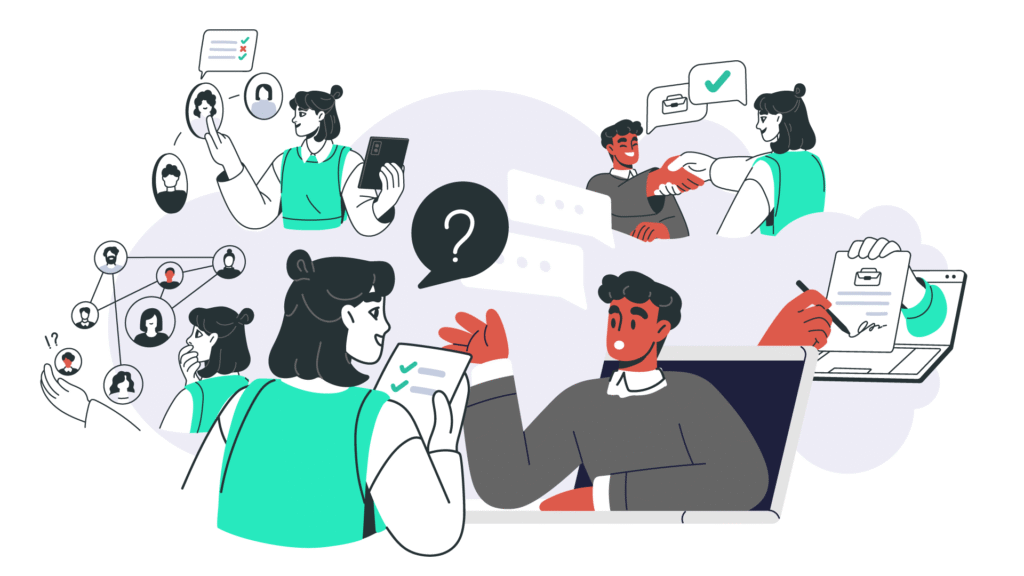
A remote hire can ace the interview, submit a polished resume, and reply from a company inbox. None of that proves who is actually behind the process.
That gap matters once a new hire touches sensitive data, signs into privileged systems, or represents the business to customers. Remote hiring identity verification closes it. The check confirms a real person joined the workforce, matches the identity on file, and isn’t sharing or duplicating access.
Treat it as one layer among several, not a replacement for required employment checks. The real task is separating the risks, then matching each one to the smallest signal that resolves it.
Ghost workers turn one hire into a hidden risk
In a ghost-worker scheme, a company hires one identity while a different person does the work. The arrangement creates real exposure wherever the role touches customer data, source code, financial systems, or regulated workflows.
This isn’t hypothetical. On 31 July 2026, agencies from 11 countries warned that North Korean IT workers are using false identities, proxies, and AI tools to land remote jobs, then funnelling wages back to state agencies. The US Department of Justice has already acted on it: in one week in June 2025, the FBI searched 21 suspected “laptop farms” across 14 states, seizing devices set up to run stolen identities from overseas.
“Two out of three organizations have already been hit by a deepfake.”
— Gartner, August 2025
Account sharing causes a quieter version of the same problem. One worker hands a login to a colleague. A group shares a single profile. Standard credentials confirm the password was correct. They don’t confirm who typed it.
Impersonation and synthetic identities complicate the picture
Impersonation can start before the interview or resurface later, when a worker requests access to a sensitive system. Synthetic identities are harder to catch. They blend real and fabricated details into a profile that clears surface checks, even without a genuine person-to-account relationship behind it.
Employment eligibility checks and document review answer legal questions. They don’t confirm a live human is present, or that one person controls the account. A document can match the application while the person holding it isn’t the one who uses the account later.
Related reading: synthetic identity fraud detection explains why plausible details aren’t the same as a trustworthy identity signal. Document vs. human verification covers the distinction in more depth, and fraud rings and coordinated account abuse shows what synthetic identities look like at scale.
What should a remote hiring check prove?
A remote hiring check should answer one clear question: employment eligibility, identity binding, human presence, uniqueness, or post-onboarding account security. Treating one control as proof of all five makes the process harder to govern and to explain to candidates.
| Control | Question it answers | What it doesn't prove alone |
|---|---|---|
| Document review | Are the required documents present and genuine? | That the applicant is unique or stays in control of the account later. |
| Identity binding | Is the verified person tied to this specific hiring or workforce account? | That the person stays live at every future sign-in. |
| Human presence | Is a real person here now, not a bot or a replay? | Employment eligibility or uniqueness across a platform. |
| Uniqueness | Is this one distinct person, not several identities run by one individual? | Eligibility to work or future account security. |
| Post-onboarding monitoring | Has ownership or access changed in a way that warrants review? | That the original hiring checks were complete. |
Form I-9 stays on its own track
In the US, Form I-9 remains a separate compliance process. Employers enrolled in E-Verify in good standing can use a DHS-authorized remote alternative at eligible hiring sites. That procedure requires a live video interaction while the candidate presents documents, plus clear copies of both sides of any two-sided document.
USCIS requires employers to apply the alternative procedure consistently across every employee at that site. None of this replaces a human-presence or uniqueness check — it answers a different question. USCIS remote examination guidance covers the current rules.
“In one week in June 2025, the FBI searched 21 suspected ‘laptop farms’ across 14 states — evidence that ghost-worker schemes run at scale.”
— US Department of Justice
Build the workflow as a sequence, not one big check
Map role risk first, then apply each control at the point it earns its keep. A contractor touching source code needs a different sequence from a short-term admin hire.
| Step | What it does |
|---|---|
| 1. Risk-map roles | Match controls to what a compromised hire could actually access. |
| 2. Collect minimum signals | Keep employment, contact, and identity data in separate domains. |
| 3. Verify documents where law requires it | Follow the applicable Form I-9 process for US hires. |
| 4. Run human-presence and uniqueness checks | Place them before account creation or privileged access. |
| 5. Route exceptions | Give a trained reviewer only the evidence needed to decide. |
| 6. Retain evidence with access controls | Encrypt, log access, and set deletion rules before launch. |
| 7. Monitor after onboarding | Track exception rates, overrides, and repeat identity signals. |
Privacy and friction belong in the same decision
Data minimization means collecting only what a decision requires. A document review supports employment eligibility. It doesn’t mean every downstream system should keep a copy, or that a human-presence check needs to become a document archive.
Candidates notice disproportionate friction. A process that repeatedly asks for sensitive information, explains little, and offers no recovery path makes people question how their data will be used. That drags down completion rates and creates support work.
VerifEye handles this trade-off by design. It runs on-device, skips image storage, and follows GDPR-by-design principles, so it confirms real human presence without turning onboarding into a document-heavy process. Ethical identity verification systems covers the wider principles.
Where human-presence checks fit in onboarding
The right checkpoint tracks a change in risk, not the existence of a form. Run a check when a candidate accepts an offer and creates an employee account. Run a second check before granting privileged access: production permissions, an admin console, or regulated data. A sensitive change, like updating recovery details or reopening access after a security event, can justify a fresh signal too.
“The goal isn’t proving every candidate is a suspect. It’s proving the person behind the account is real.”
— Realeyes
Human presence doesn’t replace Form I-9 or other document obligations. It adds a layer focused on who’s participating, not just what’s on the page. VerifEye runs a fast, on-device presence check without storing images, so it adds that layer without adding friction. Device-bound identity vs. human verification goes deeper on the mechanism.
How to evaluate a verification approach
Judge an approach on six things: coverage across roles and jurisdictions, proportionality to risk, privacy design, integration with existing systems, exception handling, and measurable outcomes. A pass or fail result only helps if the organization can explain what it proves, where the data goes, and how failures get handled.
Check what a vendor collects, where it processes data, and how long it keeps it. On-device processing without image storage limits breach exposure and speeds up privacy reviews. Confirm the workflow handles different devices, connections, and accessibility needs, with a defined exception path. See the VerifEye identity verification API for what that integration looks like in practice.
Frequently asked questions
What is remote hiring identity verification?
A layered process that confirms a candidate is who they claim to be, that a real human is present, and that they aren’t running multiple identities. It combines employment eligibility checks, identity binding, live human-presence signals, and monitoring after onboarding.
Does a human-presence check replace Form I-9?
No. E-Verify employers in good standing can use a DHS-authorized remote alternative for Form I-9, but it still requires a live video interaction and clear document copies. USCIS explains the requirements here.
How should companies verify remote contractors?
Start with the access and fraud risk of the engagement. Verify identity with the minimum necessary signals, confirm a real human is present, and apply uniqueness checks where account sharing matters. Keep an exception path open for accessibility or document issues.
How can employers protect candidate privacy during verification?
Collect only what the decision requires, set retention and access rules before launch, and skip storing sensitive images when they aren’t necessary. On-device processing without image storage supports that approach directly.